
The Goosewarden
When War Came Home

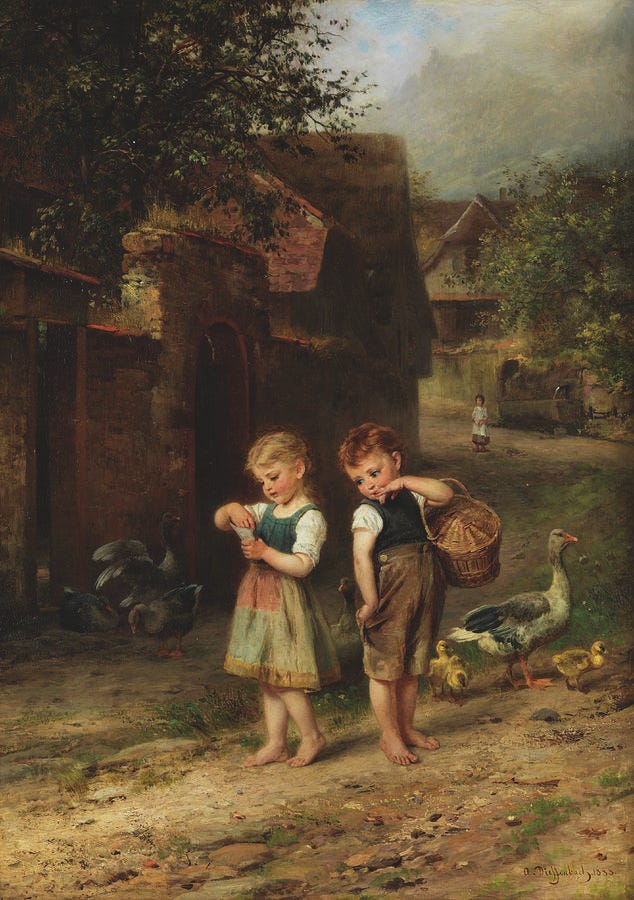

I.
He kept the geese because they were alive.
Not because he liked them—though he did, in his way—but because they did not look at him with the old soldier’s measuring eyes. They did not wonder what he’d done with his hands during the war, or what he’d refused to do when his captain shouted. They did not care what he had seen burning on the road, or how long he had stared into fire afterward, waiting for something to crawl up and speak in the embers.
Geese looked at him as though he was the center of the world.
A man could live on that, if he had to.
He walked before dawn, while the village still wore its sleep like a blanket and the roofs were the color of ash. The fields were silvered with frost. His breath came out in soft clouds, and the geese—twenty-three of them this season, and one of those a fool—moved behind him with the steady confidence of a marching host.
They did not waddle like hens.
They advanced.
“Keep tight,” he murmured, the way he might once have murmured to men in armor, though he had never been much of a leader. “No one wants to be the first to the pond. Not you, Freckle. Not today.”
Freckle was the fool goose, a white one with an eye that always seemed slightly offended, and he took this as a personal challenge. He surged forward, neck extended, feet slapping wet grass, flapping his wings with the heroic uselessness of a banner.
The man sighed and lengthened his stride. His boots were worn thin. A patch of heel leather had been stitched twice already, and still water found its way in. He didn’t mind. Wet feet were not the worst thing he’d had.
Behind him, in the dim spill of the waking day, Grenton waited in its hollow: small, stubborn, and old. A village of eight score souls, if you counted babies and very old men as souls. A church with a bell that rang dull because the crack had never been properly mended. A mill by the stream that worked only when the water felt kind. Two alehouses, if you counted the widow’s kitchen and the fact that people kept paying for drink there.
Grenton had no wall. Grenton had no guard.
Grenton had geese.
And, so the reeve liked to say, a gooseherd who used to be a soldier.
He hated that last part.
He had come back from the war with a torn ear and a scar down his forearm that looked like a pale worm. He had come back without the hunger for it, which men did not forgive. They forgave missing limbs more easily than they forgave missing devotion.
Still, the village tolerated him, and in small places tolerance was a kind of love.
He led the flock down toward the stream, where the reeds grew thick and the mud held the print of every hoof and boot for half a day. Mist lay low, and the morning smelled of wet leaf and cold clay.
The geese spread out as soon as they reached water, immediate as breath. They dipped their heads, shook themselves, muttered and hissed to one another in low complaints about nothing and everything. A few drifted off to nibble grass. One tried to bite his boot and received a steady look.
“Not me,” he said softly.
The goose blinked, as though surprised that he had opinions.
He watched them the way other men watched walls. The flock had become his perimeter. Their eyes were sharper than people guessed. Their hearing, too. When they went still and their necks rose in unison like reeds stiffening in wind, it meant something had moved where it ought not.
He had learned that. Slowly. Like everything else that mattered.
A little sound came from the path behind him: footfall on hard ground, careful and not quite sure it belonged there.
He did not turn at once. He listened. The geese did, too. Several lifted their heads, water dripping from their bills. Freckle went to the edge of the stream like a knight taking his place at the gate.
The man said, “If you’ve come to steal eggs, you’re late. They’ve been broody for weeks.”
A laugh, wary and amused. “Saints preserve me. He talks to them.”
He turned then.
A boy stood a few paces back, shoulders hunched in the cold. Not a small boy—a lad, perhaps thirteen or fourteen—skinny as a broom handle, hair sticking up in every direction. He wore a wool cap too big for him and a tunic that had been patched with fabric that didn’t match anything it touched.
It was Marn, the miller’s youngest.
Marn stared at the geese like they were a miracle. Not the kind sung about in church. The kind that chased men.
“You should not be here,” the man said.
“I was sent.”
“By who?”
“The reeve.”
That explained it. The reeve loved sending boys on errands that involved cold mud. It gave him the sensation of governance.
Marn shuffled closer. Freckle hissed, and the boy jerked to a stop as though faced with a drawn blade.
“Tell your goose to stop,” Marn demanded, voice cracking with fear and indignation.
He looked at Freckle. “Stop.”
Freckle did not stop. Freckle had never stopped in his life.
The man spread his hands. “He is faithful. He has been told many things. Stopping is not among them.”
“You’re joking,” Marn said, but he sounded relieved, like the world was still allowed to have foolishness in it.
“A bit,” the man admitted.
Marn cleared his throat, trying to look official. “The reeve says… the reeve says the village needs you at the green.”
He felt the familiar tightening in his stomach, the small, cold hand of duty. It had haunted him since he first picked up a spear. Duty was always clumsy, always poorly timed, always asked for by men who did not carry it themselves.
“Needs me for what?”
Marn’s eyes darted away, as though the words might bite. “A stranger came. From the road. He’s got news.”
The geese had begun to stir oddly, little murmurs moving through them like ripples. Not alarm, not yet. Something else.
The man narrowed his eyes. “What kind of news?”
Marn swallowed. “Bad kind.”
That was the sort of answer that earned a boy a scolding in most households. Here it earned him a nod.
He reached for his staff—oak, worn smooth from years of use. It was not a weapon, though it could be, if you struck the right part of a head. He had once known all the right parts.
The geese sensed he was leaving and immediately became offended by it. Several honked loud enough to rattle the reeds. One ran forward, flapping its wings as though trying to herd him back where he belonged.
“All right,” he muttered, half to them, half to himself. “All right. I’m coming back.”
Freckle honked at him like a judge.
He gave the flock the signal he’d trained them to recognize: two short taps of the staff against the ground, then a slow sweeping motion toward the upper bank. It was simple. It had to be. Geese did not respect complexity.
Most people didn’t, either.
The flock drifted in the direction he indicated, grumbling and muttering, nipping each other like men in a queue. Freckle continued to act like the commander of the operation, herding the others with relentless enthusiasm and occasionally biting someone that wasn’t moving fast enough.
Marn watched, wide-eyed. “You trained them.”
“I fed them,” he said. “They trained me.”
The boy followed him up the bank, keeping a careful distance from the flock. “Do they… do they listen to you?”
He shrugged. “They have their own religion.”
The village green was little more than a stretch of packed earth near the church, where grass fought and lost every spring. By the time he arrived, people had begun to gather—women with aprons, men with tools still in their hands, children clinging to skirts. The reeve stood near the well like a man practicing for a statue.
Beside him sat a stranger on an upturned barrel.
The stranger’s cloak was travel-stained. He held it tight, but his boots were good leather and his belt was new. A man who’d been on the road long enough to look poor and yet still had money.
That could mean many things. None of them kind.
The reeve spotted the gooseherd and lifted his chin as though approving of the fact that the village’s only martial asset had arrived.
“There he is,” the reeve said, and a few heads turned with that peculiar, embarrassed interest people had whenever the war drifted into view.
The man kept his face empty.
He stood with Marn at the edge of the gathering. His geese trailed behind him at a respectful distance. Respectful for geese, which meant they were only about ten paces away and already trying to taste the hems of skirts.
A woman shooed at them with her elbow. The geese honked at her as though she’d insulted their mothers.
The reeve clapped his hands.
“Quiet,” he said, and Grenton became quiet in the way of small places—quiet but still breathing, still listening, still refusing to stop being alive.
“This man,” the reeve announced, gesturing grandly at the stranger, “has come from the western road with tidings.”
The stranger looked out at the villagers, weighing them. His eyes were pale and tired. He had the look of someone who had slept in ditches. Or made others sleep there.
He spoke without standing. A subtle arrogance. A practiced one.
“There’s been trouble,” he said.
A murmur went through the green.
“What kind?” called someone, too quickly.
The stranger’s gaze flicked over the crowd and landed, eventually, on the gooseherd.
The man felt it like a hand on the back of his neck.
The stranger said, “Deserters.”
The murmur became thicker.
“From the king’s war?” asked the blacksmith, voice already hardening with anger. He had three sons. He didn’t know which ones would come back. That made his temper sharp.
The stranger nodded. “Men who left the banners. Men who’ve decided they’d rather live by taking than die for nothing. They’ve turned to the roads. They’ve taken two hamlets already. Burned one. Left it black and empty.”
A woman made a sound like she’d been struck.
Someone crossed themselves.
The reeve said, quickly and too loudly, “But we are not on a major road. We are not a prize.”
The stranger gave him a look that made the reeve shrink in his own coat.
“They don’t take prizes,” the stranger said. “They take bread. They take boots. They take girls. They take whatever looks like it will make tomorrow easier.”
The village went very still.
The geese honked once, as if commenting.
The gooseherd’s fingers tightened on his staff. He hated the way the words settled into people, heavy and helpless. He hated the way the reeve’s mouth kept working, trying to produce authority out of fear.
The reeve cleared his throat. “How many are they?”
The stranger scratched his jaw. “A dozen, maybe more. Hard to count from trees. They keep moving. But they’re armed. Some have mail. Some have bows. One has a horse.”
A horse.
That was what made the danger real. A horse was power: distance and speed and force.
The reeve’s eyes darted toward the gooseherd again, and the man knew what would come before it did.
“You fought,” the reeve said, as if offering it like currency. “You would know… you would know what to do.”
He did not correct him. Not here. Not now.
He said, quietly, “When did you see them?”
“Yesterday,” the stranger replied. “Near the old boundary stones. They were heading east.”
East meant them.
East meant Grenton.
The villagers began to speak all at once—fear poured into words like water into cracks.
“We should hide the grain—”
“Send for help—”
“There is no help—”
“My daughters—”
The reeve raised his hands and failed to gather the noise back into himself. He was not that kind of man.
The gooseherd turned slightly, letting the sound wash over him the way he’d once let the sound of soldiers shouting wash over him before a charge. Panic always sounded the same. It made no difference if it wore armor or an apron.
He watched the stranger. Watched the way his eyes kept moving, measuring faces, measuring fear.
Then the stranger’s gaze returned to him.
“You,” the stranger said, voice almost casual. “You’re the one they told me about.”
The man did not move. “What did they tell you?”
The stranger smiled faintly. Not warmth. Something else.
“That there’s no guard here,” he said. “Only a man with geese.”
The villagers laughed nervously, grateful for any crack of humor. Even the reeve managed a small, strained chuckle.
The gooseherd did not laugh.
Because he knew what the stranger meant.
If you were a thief, and you heard there was no guard—only geese—you might come.
If you were a thief, and you wanted to know what kind of fight you’d have, you might send someone ahead to look.
A messenger. A traveler.
A man on a barrel, watching.
The gooseherd looked down.
One of his geese had edged close to the stranger’s boot. It stared up at him, head cocked. A moment of stillness.
Then, slowly, the goose’s neck rose.
The flock, behind him, went quiet. Not the quiet of contentment.
The quiet of attention.
The gooseherd felt the hairs on his arms lift.
The goose opened its bill.
Hissed.
The stranger’s smile faltered.
He shifted his foot, just slightly, as though he did not like the feeling of being judged by a bird.
The gooseherd spoke softly, voice low enough that only the nearest could hear.
“You’ve been around campfires,” he said.
The stranger blinked. “What?”
“Your cloak,” the man said. “Smells like old smoke. And sweat. And men.”
The stranger’s eyes hardened.
The gooseherd leaned his weight onto his staff. He kept his face mild.
A goose, behind him, honked once, short and sharp. Another answered. The sound traveled through the flock like a warning bell.
People turned their heads, confused. Geese didn’t behave like that for nothing.
The stranger’s hands tightened on his knees.
The reeve frowned. “What’s the meaning of this?”
The gooseherd did not look at him. He kept his eyes on the stranger.
“You should leave,” he said quietly.
The stranger’s voice was flat now. “Or what? Your birds will peck me to death?”
Freckle chose that moment to surge forward out of the flock like a champion launched from heaven. He darted straight toward the stranger, wings half-raised, bill snapping.
The stranger jerked back, startled. The barrel creaked.
Freckle bit his boot.
Hard.
The stranger swore and kicked, but Freckle was already retreating, honking like a victorious lunatic.
Half the village laughed in spite of themselves.
The reeve shouted, “Control your animals!”
The gooseherd said, calmly, “I am.”
The stranger stood. He was not laughing now.
He looked at the villagers, then at the gooseherd, then at the flock behind him like a living, watchful fence.
He took a slow step backward.
“Very well,” he said. “You’ve made your point.”
He turned and began to walk away.
And as he did, the gooseherd saw it. One brief motion beneath the cloak as it shifted: the outline of a blade at his belt, hidden but present. Not the knife of a traveler who feared wolves.
The knife of a man who expected to use it.
The stranger reached the edge of the green, paused, and glanced back.
His eyes met the gooseherd’s.
Something unspoken passed between them.
Then he was gone down the road, his cloak swallowed by morning and frost.
For a moment nobody moved.
The reeve spoke first, voice unsteady with anger and relief.
“What,” he demanded, “was that?”
The gooseherd looked at him, and for the first time his expression cracked.
“That,” he said, “was not news.”
He turned to Marn, who was staring after the stranger with his mouth slightly open.
“Marn,” he said, “run to the mill. Tell your father to stop the wheel and bar the door. Tell him to take the flour and hide it in the loft.”
Marn didn’t move. “Why?”
The gooseherd’s eyes swept the village—women, children, tired men, the cracked bell tower, the open roads.
“Because,” he said, and his voice stayed low, steady, almost gentle,
“they know we’re here now.”
The flock behind him began to stir again, restless as wind in reeds.
And Freckle, still drunk on victory, honked once more like a trumpet.
Somewhere far off, beyond the boundary stones, a raven called.
And Grenton, small and unarmored, held its breath.
II.
They argued about it for an hour, which was how Grenton dealt with anything that frightened it.
The reeve called it council. The villagers called it standing around until our fear turns into words we can hold. The gooseherd called it time being spent by people who had never known how quickly the world could turn.
They crowded into the church because it was the only place that felt like it belonged to everyone. The nave smelled of damp stone and old wax. The saints stared down from faded paint, faces half-erased by time and smoke. The bell rope hung like a dead vine.
Freckle strutted down the center aisle with the boldness of a visiting king.
The priest, Father Oswin—soft-bellied and tired-eyed—waved his hands. “Not in here, please. Not in the Lord’s house.”
Freckle lifted his head and honked once, as if to say: the Lord made me too.
The gooseherd caught Freckle by the neck in one calm motion, not choking, not cruel, just holding him like a sack of grain. Freckle protested with offended mutters.
“Outside,” the man told him.
Freckle bit his sleeve as he passed, as if to remind everyone he was not being defeated, merely relocating.
He shut the church door behind the flock, but the geese remained pressed against it like a listening wall. Every so often they would honk, and the whole room would jump, and then people would laugh nervously, as if a laugh could protect them.
At the front of the church, the reeve paced like a man trying to walk his fear into usefulness.
“We should send for the lord’s men,” he said again, for perhaps the seventh time.
“And have them arrive after we’ve been eaten,” the blacksmith replied. His arms were crossed, muscles hard with the work of his trade. “They’ll show up to count corpses and call it justice.”
“That’s blasphemy,” Father Oswin muttered.
“It’s arithmetic,” the blacksmith snapped.
The reeve glared at him. “We have rights. We have obligations. We are not rats.”
“We are eight miles from the lord’s nearest outpost,” the miller said. “And the stream’s been low for weeks. If they take the flour, we’ll starve before summer. I don’t care what we’re called.”
Voices rose. Men talked over women. Women spoke anyway. Children listened like little ghosts.
The gooseherd stood near a pillar, his staff resting lightly under his hand. He watched, quietly, like a man watching a pot boil. There were times to speak, and times to let people spill themselves out first.
At last, the reeve pointed at him as though accusing him of existing.
“What do you say?” the reeve demanded. “You stood there on the green like you knew more than the rest of us.”
A dozen eyes swung toward him.
He felt it, the pressure of being a thing people could lean on. He hated it. He had hated it in camp, too, when men looked at him to make decisions he didn’t want. It was never the brave ones who got asked. It was the ones who seemed calm.
He cleared his throat.
“They won’t attack today,” he said.
A silence dropped, immediate.
The reeve blinked. “How could you possibly know that?”
The gooseherd’s voice stayed mild. “Because if they wanted to attack today, they would have already.”
“Or they’re waiting to gather more men,” someone said.
“Or waiting for night,” someone else whispered.
He nodded once, conceding both possibilities. “Yes. They might.”
The reeve threw his hands out. “That’s not comfort.”
“It’s truth,” the gooseherd said. “Truth is what you build plans from.”
The blacksmith studied him with narrowed eyes. “What plan do you have?”
The gooseherd hesitated.
The church creaked around them, old wood settling, stone holding cold. Somewhere behind the doors, the geese shifted and muttered like soldiers outside a hall.
He heard the war in the sound of the villagers’ breathing. He heard it in the way people hunched their shoulders, as if they were already bracing for blows.
He said, softly, “Do you know why I keep geese?”
Someone scoffed. Someone laughed once, then stopped.
The reeve’s expression twisted with impatience. “Because you like birds.”
“I don’t,” the gooseherd said.
That earned him a few surprised stares.
He looked down at his hands. Scarred. Callused. A hand that had held a spear, a hand that had steadied a dying friend, a hand that had pushed a man away and refused an order.
“I keep them because they don’t lie,” he said.
No one spoke.
He continued, quiet as an ember. “A dog can be bribed. A man can be reasoned with. A horse can be frightened. But a goose… a goose is honest. It tells you what it feels, and it tells you loudly.”
A little laughter softened through the room, and he let it.
“And geese,” he added, “do not like strangers.”
The blacksmith’s mouth twitched. “No, they do not.”
The reeve rubbed his face, as if he could wipe the fear off. “You can’t mean to fight armed men with… honking.”
The gooseherd looked up.
“I don’t mean to fight them,” he said. “I mean to stop them.”
Father Oswin exhaled, confused. “How?”
He turned his head slightly, listening.
Outside, Freckle honked again, one sharp note, then another. It wasn’t random. It had a pattern. The flock answered in a low chorus.
The gooseherd’s eyes narrowed.
“You hear that?” he asked.
The reeve frowned. “Hear what?”
The gooseherd went to the door, opened it a hand’s breadth.
The geese were bunched together, necks raised, facing toward the eastern road. The entire flock had gone rigid. Even Freckle’s foolishness had been replaced by something cold and serious.
The gooseherd shut the door again.
“They’re not honking at nothing,” he said.
A hush swept the church.
The blacksmith’s hand went to the hammer at his belt, instinctive. A few men shifted, suddenly remembering they owned knives and axes. Not weapons, not really, but tools had edges.
The reeve said, carefully, “Is someone there?”
The gooseherd didn’t answer. He walked to the small window near the door and peered out.
At first he saw only frost and pale grass.
Then he saw movement near the boundary path, far enough away to be cautious, close enough to be seen.
A figure.
Then another.
Three men, half-hidden by the fold of the land, watching the church.
They were not villagers. Their clothing was wrong, too patched, too grimy, too ready for the road. One of them wore a helmet that didn’t belong on a farmer. Another carried a bow, held loose in his hand like a threat that hadn’t yet decided to speak.
Scouts.
Testing.
The gooseherd turned from the window and faced the room.
“They’re here,” he said.
A sound rose in people’s throats. Not screaming yet. Just the beginning of it.
The reeve’s face drained. “Saints…”
Father Oswin crossed himself and whispered something under his breath.
The blacksmith spit on the stone floor. “Cowards.”
The gooseherd lifted his staff.
“Listen,” he said.
The word wasn’t loud, but it landed. It had the weight of a command. People quieted because they wanted to believe someone else could carry the fear for them.
“They’re scouting,” he said. “That means they don’t know what we have.”
“What we have?” the reeve echoed, almost hysterical. “We have nothing.”
“We have each other,” the miller muttered.
The gooseherd nodded once. “And we have geese.”
The reeve looked like he might weep.
The gooseherd continued anyway. “They’ll come tonight, or they’ll come in the morning. They’ll come when they think we’re weakest.”
The blacksmith’s gaze stayed hard. “So what do we do?”
The gooseherd took a breath.
This was the part he hated. This was the part where men listened and then bled.
But he wasn’t a captain anymore. He wasn’t under banners. He wasn’t taking lives for lords who couldn’t remember faces.
This time, he was trying to keep people alive.
He said, “We show them teeth.”
“Whose teeth?” the reeve snapped. “Yours?”
The gooseherd’s eyes flicked toward the door, where muffled honking and scratching persisted like impatient drumming.
“Theirs,” he said.
They prepared all day.
In Grenton, preparation looked like improvisation wearing a serious face.
The blacksmith dragged an old wagon wheel into the road and propped it up with stones to make a barrier. The miller and two boys carried sacks of flour into the loft and covered them with straw, like hiding treasure. The women moved quietly through the village, collecting children into houses, turning hearths into gathering places.
Father Oswin rang the cracked church bell twice at noon, then stopped, as if afraid the sound might summon the brigands faster.
The reeve marched through the lanes, pretending he knew what he was doing.
The gooseherd went to the stream and the pond and the little marshy edge where the geese liked to forage. He moved among them slowly, staff tapping, voice calm. They followed him like a living cloak, grumbling but compliant.
He didn’t train them with cruelty. He never had.
He trained them with repetition and food and certainty.
A goose needed to believe you knew where you were going.
People did too.
He chose three places:
The eastern path, where the scouts had been seen.
The narrow lane between the alehouse and the baker, where two men could not stand shoulder to shoulder without touching.
The green behind the church, where the well sat like a mouth and the ground was hard.
He showed the flock those routes again and again, guiding them like water through channels.
He tapped his staff twice for follow.
Three taps for hold.
A wide sweep for go.
Freckle learned it fastest, which was infuriating and somehow fitting. The fool goose had the heart of a champion and the brain of a pebble, but his loyalty was absolute.
At one point, as the sun leaned into late afternoon, Marn followed him to the pond again, trying to be brave enough to watch.
The boy had brought a strip of dried fish as an offering, held out like a peace treaty.
Freckle snatched it so violently Marn yelped and fell backward into mud.
The gooseherd didn’t laugh, but his eyes softened. “He likes you.”
Marn sputtered, wiping mud from his sleeve. “He tried to take my hand off.”
“Yes,” the gooseherd said. “That’s affection.”
Marn stared at him. “Are you not afraid?”
The gooseherd paused.
Afraid.
It was an old word, and he wore it in his bones like winter.
“I’m afraid all the time,” he admitted.
That surprised the boy.
The gooseherd crouched, scooping a bit of mud between his fingers. It was cold. Thick. Real. He looked at it like a man trying to remember the world.
“I’m afraid of men with knives,” he said softly. “I’m afraid of what happens when hunger meets cruelty. I’m afraid of being asked to do violence again.”
Marn swallowed. “But you will, won’t you? If they come?”
The gooseherd stood.
His eyes went to the village, small, crooked homes, smoke curling, the smell of bread and dung and peat. The sound of a mother singing softly inside a doorway.
He looked down at his geese, each one alive, stubborn, loud.
He said, “No.”
Marn blinked. “No?”
The gooseherd’s voice was steady. “I won’t kill them.”
Marn looked confused, almost offended on behalf of the village’s fear. “But what if they hurt someone?”
The gooseherd leaned on his staff. “Then I’ll stop them.”
“How?” the boy demanded.
The gooseherd’s mouth twitched, the smallest hint of humor. “With geese.”
Marn stared, then gave an uncertain laugh.
It wasn’t a laugh of mockery.
It was a laugh of a boy trying to believe in something ridiculous because the alternative was unbearable.
As twilight came, the village closed like a fist.
Doors were barred with wood and prayer. Windows were shuttered. The alehouse extinguished its lantern early, and the widow who ran it handed out cups of thin ale like it was medicine.
The reeve ordered every man with an axe to stand watch at intervals along the lane.
They looked like woodcutters waiting for wolves.
The gooseherd stood on the green.
His flock was gathered behind the church, clustered in the shadowed grass, restless and murmuring. Their bodies were pale lumps in the dusk, their eyes catching the last light like beads.
Freckle patrolled the edge of the group, vigilant as a knight.
The blacksmith came and stood beside the gooseherd, holding a hammer that suddenly looked too small to matter.
“I don’t like this,” the blacksmith said.
“I don’t either,” the gooseherd replied.
The blacksmith’s gaze stayed on the road. “You really think they’ll come?”
The gooseherd nodded once. “They came to look. They’ll come to take.”
The blacksmith’s jaw tightened. “Then why didn’t you warn the lord sooner? Before all this?”
The gooseherd’s eyes stayed forward.
“Because the lord’s men,” he said quietly, “would come here and do what soldiers do.”
The blacksmith looked at him.
The gooseherd’s voice was low. “They would hang them. Or cut them down. And if any of them tried to run, they would chase them through fields that belong to people who can’t afford trampled crops. And afterward, they’d demand payment for the trouble.”
The blacksmith grunted. He couldn’t argue with it.
“And what would you do?” he asked.
The gooseherd’s grip tightened on his staff. “I want them gone.”
The blacksmith’s eyes flicked toward him. “That’s all?”
“That’s all,” the gooseherd said.
A long silence settled.
Then, far down the eastern road, the geese began to stir.
A low muttering moved through them. Necks rose. Bodies tightened.
The gooseherd felt his blood slow. His senses sharpen.
He lifted his hand, palm down.
The flock quieted.
Even Freckle froze.
Somewhere beyond the boundary stones, the world moved.
A sound carried through the night, soft at first, almost nothing.
Footsteps.
Not one man.
Many.
The blacksmith whispered, “Saints preserve us…”
The gooseherd breathed out slowly.
“Hold,” he murmured.
The geese held.
They were waiting.
So was he.
And down the road, in the thickening dark, a shape detached itself from the trees. Then another, then another, until the path itself seemed to fill with men.
They moved like a shadow spilled into the world.
And when the first brigand stepped into the faint reach of Grenton’s outer fields, the gooseherd saw the flash of metal at his side.
A sword, notched and ugly.
A deserter’s prize.
A man’s last comfort.
The gooseherd raised his staff.
Not high.
Not dramatic.
Just enough for the flock to see it.
His voice, when he spoke, was a whisper meant only for birds and God.
“Now,” he said.
And the geese surged forward like white fire.
III.
The first sound the brigands heard was not a shout.
It was not steel sliding free of leather. Not the stamp of a horse. Not the warning cry of a watchman.
It was a honk, sharp as a trumpet in the night.
Then another.
Then a rolling chorus, swelling up from the dark behind the church like a hundred small souls being ripped awake.
The flock came low over the grass at first, bodies pale and furious, wings half-spread like sails catching wind. Their feet slapped mud and frost with wet violence. Their necks reached forward, and their eyes—those black, bright, honest eyes—fixed on the intruders with the calm certainty of creatures born to defend what they loved.
The brigands stopped short.
Some laughed.
One of them said, “What in God’s—”
Then Freckle hit the front line like he’d been fired from a catapult.
He launched himself at the nearest man’s shin with a mad, righteous devotion, biting down and holding. Not pecking like a chicken, but clamping like a trap.
The man yelped and stumbled.
Another goose caught the back of his boot and began to drag, hard enough to pull leather loose. A third went for his fingers as he reached down to strike. The brigand jerked back with a curse and swung his arm wide.
His fist hit nothing.
He had never fought birds before.
Most men hadn’t.
The flock surged into them like a wave that refused to be reasoned with. The lane filled with bodies, men and goose and wing and panic, until the brigands’ formation broke apart without even realizing it had been a formation at all.
In war, men learned to hold a line.
In Grenton, the line was feathered.
The gooseherd stood on the green with his staff raised, not like a general, but like a man holding a door open for a storm.
He listened.
The honking was thunder.
The men’s shouts were wind-choked.
And beneath both, the strange, gleeful sound of chaos doing God’s work.
One brigand ran forward anyway, trying to push through the flock, sword half-drawn. He kicked at geese, boots thudding soft bodies. He had the furious desperation of a starving animal.
The gooseherd’s eyes tracked him.
He knew that desperation. He had lived among it for months.
He stepped into the lane.
The brigand saw him, and something flickered in his face: recognition, or the anticipation of it. A soldier’s instinct sniffing another soldier out.
“You,” the brigand snarled, pointing his blade. “You’re the guard?”
The gooseherd didn’t answer the question. He didn’t give it the dignity of being spoken aloud.
“I’m the gooseherd,” he said.
The brigand barked a laugh that sounded like a cough. “Then call them off.”
The gooseherd’s voice stayed quiet. “Leave.”
“Leave?” the brigand spat. “We’re hungry. We’ve walked three days. We’re owed—”
“Owed?” the gooseherd repeated, and the word came out colder than he intended. It carried a shape from old fires, old corpses, old sermons shouted by captains who never bled.
The brigand took a step forward.
The gooseherd saw his hands, scarred too. Callused. A man who had once held tools, or held a spear. The brigand’s face was grimy, but not stupid. The eyes were the worst part: tired, hollow, still angry at the world for not loving him.
A deserter.
A man who had run from death and found another kind of it waiting.
Behind the brigand, the rest of the gang was unraveling.
One man had climbed onto a stone and was swinging a cudgel wildly at the flock, shouting curses that sounded like prayer gone rotten. Another was backing away with his hood pulled up, trying to protect his face from beaks. A third was on his knees, shrieking as two geese fought over his belt like it was a worm.
In the dark, geese were relentless.
They didn’t stop because a man pleaded.
They didn’t pause because a man swore.
They only stopped when the threat left, or when the Goosewarden told them the world was safe again.
The brigand raised his sword. “If you won’t call them off, I’ll cut you down and—”
The gooseherd moved.
Not fast with fury.
Fast with memory.
He stepped inside the sword’s reach the way he’d once stepped inside a spear’s reach, the only way to make long steel useless. His staff came up and struck the brigand’s wrist. Not breaking, not crushing, just sharp enough to force pain into obedience. The sword clattered into the mud.
The brigand gasped, shocked, and the gooseherd caught his collar with his free hand and shoved him backward, hard.
Not onto the ground.
Into the geese.
The flock swarmed him immediately. Wings and honks and biting, not deadly, never deadly, but humiliating and overwhelming.
The brigand screamed like a man being baptized in madness.
The gooseherd didn’t smile.
But his eyes flicked, just once, toward Freckle, because Freckle was doing something spectacular.
Freckle had found the man with the bow.
The archer was trying to draw, but every time he lifted the string, Freckle lunged for his forearm. He didn’t let the bow become a weapon. He turned it into a useless stick in the hands of a panicking fool.
At last, the archer threw the bow down and backed away, hands raised.
“All right!” he shouted. “All right! Devils take you!”
Freckle honked triumphantly and chased him anyway.
The gooseherd lifted his staff and gave the signal: three sharp taps.
The flock did not stop instantly. Geese were not a disciplined regiment. But it slowed, reorganized, redirected, like a river being guided back toward its bed.
The brigands had not expected resistance. Not real resistance. Not a village that could bite back without a single proper blade raised against them.
They began to retreat.
One by one, then three at once, then in a scrambling pack, boots slipping, curses flying, hands batting at wings and snapping bills.
They ran down the road the way men ran from wolves.
They did not look back.
A few yards beyond the boundary stones, they broke into the field and vanished into darkness.
And the geese, at the Goosewarden’s signal, stopped at the edge of Grenton like soldiers halting at a line drawn by invisible ink.
Freckle wanted to keep going.
Freckle always wanted to keep going.
The gooseherd gave him a look.
Freckle, with great reluctance, returned, huffing and muttering in goose-language, wounded by the injustice of mercy.
For a long moment, there was only honking and heavy breath.
Then the village’s doors began to open.
Men stepped out holding axes and pitchforks that now looked a bit ridiculous. Women emerged with children half-hidden behind them. Father Oswin stood on the church step clutching a lantern like it was the Eucharist.
The reeve stumbled onto the green as though he’d been pushed.
He stared at the scene, mud churned by feet, feathers drifting down like snow, the gooseherd standing calm amid his flock like a saint surrounded by angry angels.
The reeve’s mouth opened.
Closed.
Opened again.
And at last, what came out was not authority, but awe.
“By God,” he whispered.
The blacksmith was laughing, a rough bark of disbelief. “You did it. You mad bastard, you did it.”
The miller’s wife wiped tears from her cheeks, half terror and half relief. “They didn’t even get to the well.”
Marn ran forward, slipping in mud, eyes huge. “You stopped them!”
The gooseherd lowered his staff. His heart was still hammering, but his face stayed steady. He didn’t let himself show what it cost him to stand in front of men with steel.
He didn’t let himself show the war waking up inside him and then, at last, going quiet again.
Freckle waddled up to Marn and bit the boy’s shoelace, as if claiming him as a trophy.
Marn yelped. “Ow! Stop that!”
The gooseherd said, without turning, “That means he approves.”
Father Oswin finally found his voice. “This… this is not proper,” he said faintly, though his eyes shone. “This is not how defense is meant to be conducted.”
The blacksmith clapped him on the shoulder. “Then it’s a good thing God loves the improper.”
The village laughed, and the laughter broke something open in the night. It was the sound of people remembering they were alive.
The gooseherd watched them.
And for a moment, he felt… not peace, exactly. Peace was a word for men who didn’t expect to be interrupted.
But he felt something like relief.
Then he raised a hand.
The laughter faded as people watched him again.
“We’re not safe yet,” he said.
The reeve swallowed. “But they ran.”
“They ran this time,” the gooseherd replied.
He looked toward the dark road.
“They’ll go somewhere else,” he said. “They’ll lick their pride and hunger. And they’ll tell themselves the village is weak, just strange.”
The reeve’s voice shook. “You mean they’ll come back.”
The gooseherd nodded once.
The villagers groaned softly, fear trying to crawl back into their mouths.
The gooseherd continued, voice even. “They won’t come back tonight. They’ve been embarrassed. They don’t want to bleed for bread. Not yet.”
He lifted his staff slightly.
“But tomorrow,” he said, “or the day after… they might come with fire. Or arrows. Or more men.”
Silence settled again, heavier this time, but clearer.
Father Oswin stepped down from the church step, lantern trembling. “Then we should pray.”
“We will,” the gooseherd said. “And we’ll do more.”
The reeve looked at him, desperate. “What more can we do? We have no soldiers. No walls. No coin.”
The gooseherd’s gaze drifted over Grenton, over the fields, the cottages, the families huddled in doorways.
Then it settled on the flock.
They were preening now, muttering, proud of themselves. A few had small smears of mud and blood on their bills, but it wasn’t serious. Nothing killed. Nothing ruined. Just the honest violence of creatures that did not understand compromise.
He said, “We learn.”
The blacksmith frowned. “Learn what?”
The gooseherd’s voice stayed soft, grounded. “We learn how to close our lanes. We learn which paths can be blocked with wagons and stone. We learn where a man can approach unseen.”
He nodded toward the church. “We use the bell properly. We don’t ring it for sermons only. We ring it for warning.”
Father Oswin’s eyebrows rose. “The bell is for God.”
“And so is survival,” the gooseherd replied.
A murmur passed through the villagers, approval, surprise, something like courage stirring.
The reeve opened his mouth, then shut it. For once, he had nothing to counter with.
Marn stepped closer, eyes shining in the lanternlight. “And the geese?”
The gooseherd looked down at him.
The boy had mud on his knees and fear still clinging to him, but he stood tall anyway. Like he wanted to be part of it, not just a thing protected.
The gooseherd said, “And the geese stay.”
Freckle honked, as if accepting his continued employment.
The blacksmith laughed again. “You’ll need a title, then.”
The reeve straightened, finding his voice again now that the danger had stepped back. “A title?”
“Aye,” the blacksmith said. “Can’t go calling him gooseherd when he’s just chased brigands off our road with a flock of demons.”
Father Oswin frowned. “They’re not demons.”
The miller’s wife said, solemn and utterly sincere, “They’re worse.”
Laughter again, this time warmer.
The reeve rubbed his chin, eyes narrowing as though trying to look wise rather than terrified. “Something official, then.”
He looked at the gooseherd. “You used to be a soldier.”
The gooseherd’s stomach tightened at the word.
He said quietly, “I used to be many things.”
The reeve blinked, then, surprisingly, nodded, as if he understood that some pasts were not meant to be held up like trophies.
He looked at the geese.
Then back at the man.
“You are… our ward,” the reeve said slowly. “Our watch. Our strange defense.”
The blacksmith grinned. “The Goosewarden.”
The word landed like a stone placed in a foundation.
The Goosewarden.
It sounded like an old story. Like a legend people would tell in winters to make children laugh and men feel braver.
The gooseherd felt his throat tighten. He didn’t know why. Titles meant nothing. Titles were what lords used to justify ruin.
But this title was different.
This one wasn’t about conquest.
It was about keeping.
He looked at the flock, and for the first time that day, he let himself smile, just slightly.
“Fine,” he said. “If you insist.”
Freckle honked loudly, as if announcing: It is decided.
Later, when the village finally went back inside and the lanterns dimmed, the Goosewarden walked the flock to the pond again.
He sat on a fallen log, staff across his knees, and watched the geese settle down in the reeds. Their bodies tucked, their heads turned, their muttering fading into soft, sleepy breath.
The night smelled of damp earth and smoke and distant frost.
He listened for footsteps.
He listened for men.
He listened for the return of the war.
But there was only the stream and the faint creak of branches.
And the geese—honest, loyal, foolish, fierce—keeping watch in their own strange way.
Footsteps came behind him, soft.
He turned, expecting another fearful villager.
Instead, it was Father Oswin, cloak pulled tight, lantern in hand.
The priest stopped a few paces away, hesitant, like he feared waking the birds.
“You did something good tonight,” Father Oswin said.
The Goosewarden looked at him. “I did something loud.”
Father Oswin’s mouth twitched. “That too.”
He stepped closer and held out something wrapped in cloth.
The Goosewarden took it carefully.
Inside was bread.
Real bread—still warm, crust crackling faintly. It smelled like life.
The Goosewarden stared at it for a moment, then looked up, caught off guard.
Father Oswin cleared his throat. “The women made it. They… they said you should eat.”
He nodded once. His voice came out rougher than expected. “Thank you.”
Father Oswin lingered, eyes thoughtful. “You didn’t kill them.”
The Goosewarden’s hands tightened on the bread. “No.”
The priest nodded, as if that answer mattered.
“They may still die,” Father Oswin said quietly. “On some road, at some lord’s hand, or from hunger. But you did not send them into death tonight.”
The Goosewarden looked out over the pond.
Geese slept like stones.
“I’ve sent enough men into death,” he said.
Father Oswin’s lanternlight trembled.
The priest said, gently, “And perhaps that is why God sent you geese instead.”
The Goosewarden didn’t answer.
Not because he disagreed.
Because the words felt too close to something true, and he didn’t want to start crying in front of a priest.
After a moment, Father Oswin turned to go.
Before he left, he paused.
“The reeve will talk tomorrow,” the priest said. “He’ll brag. He’ll make it grander than it was.”
The Goosewarden huffed softly. “Let him.”
Father Oswin smiled faintly. “And the children will tell stories. They will say you commanded a flock of winged saints.”
The Goosewarden looked down at his sleeve, where a goose bite still stung. “They’re wrong.”
Father Oswin’s smile deepened. “No. They’re right. Saints often bite.”
Then he walked back toward the sleeping village.
The Goosewarden stayed by the water, bread in his hands, geese at his back.
Somewhere beyond the boundary stones, the brigands would be nursing pride and bruises, cursing the birds of Grenton and swearing never to return.
Or swearing vengeance.
Either way, the Goosewarden would be ready.
Not with steel.
With watchfulness.
With stubborn courage.
With a flock of honest creatures who did not lie about danger—and did not hesitate to meet it with noise, teeth, and wings.
He tore the bread in half, ate slowly, and listened to the quiet.
And for the first time in a long time, the quiet did not feel like waiting for death.
It felt like home.

I really enjoy your medieval pastoral stories, they offer a nice reprieve when I get a break from work. I've never underestimated geese and thanks to this story, I guess I never will. lol
Just finished, this is excellent storytelling! I love what you’ve done with the old soldier motif—the one with a past and in need of redemption. Very creative and interesting medieval community as well. I’ll be checking out more of your stuff for sure!