
Death to the World
Youth of the Apocalypse and The Last True Rebellion

It was in the warm early months of 2025 that I stopped calling myself a spiritual intellectual and started calling myself a Christian. I remember thinking, with a kind of embarrassed honesty, Of all the minds that have come before me, how certain am I that I have somehow figured everything out? For a brief and very vain season, I believed I had. But with my sheepish toe finally dipping into the waters of Christianity, I began to realize how little I understood.
I had attended the Divine Liturgy only a handful of times, awkwardly hovering in the back, watching everything unfold and quietly wondering what kind of enlightenment these people believed they had discovered. Around that time, I first heard about a small book called Youth of the Apocalypse. I was desperate for help of any kind from anywhere. My mind felt like it was unraveling under the constant weight of questions about life, death, and whatever might lie in the terrible and mysterious place where the two meet.
So I ordered the book. I paid my ten dollars, refreshed my email obsessively, and kept glancing out my front door in the secret hope that it might magically appear overnight. Such is the modern way.
A few days later, my email delivered a different message instead:
Property vacant, returned to sender.
I stared at the screen and laughed in disbelief. Another charm of Memphis city life. Was my mailman blind to the cars in the driveway, or did he simply hate me?
I reached out to the website to explain my ongoing feud with the local post office. That was when I learned something unexpected. This was not a warehouse clearing old inventory. It was Justin Marler himself, packaging each book by hand, blessing them, and carrying them to the post office.
He replied simply, “I’ll be in Memphis in a week. My wife and I are touring the U.S. visiting parishes.”
A week later, with baklava in hand as a peace offering, I found myself meeting Marler and his wife in person. I listened as he spoke about his transformation from secular rock musician to monk, about the long journey that led him to write this book, and about the world that convinced him it needed to be written.
This is not an easy book to find. It does not live online. It does not circulate digitally. By some strange providence, it was being reprinted on its thirtieth anniversary just as I was searching for it. And by even stranger providence, the man who patiently listened to me complain about my post office placed a copy directly into my hands.
This essay is my attempt to pass that gift forward. The book meant a great deal to me. I hope the ideas inside it bring something of value to you as well.
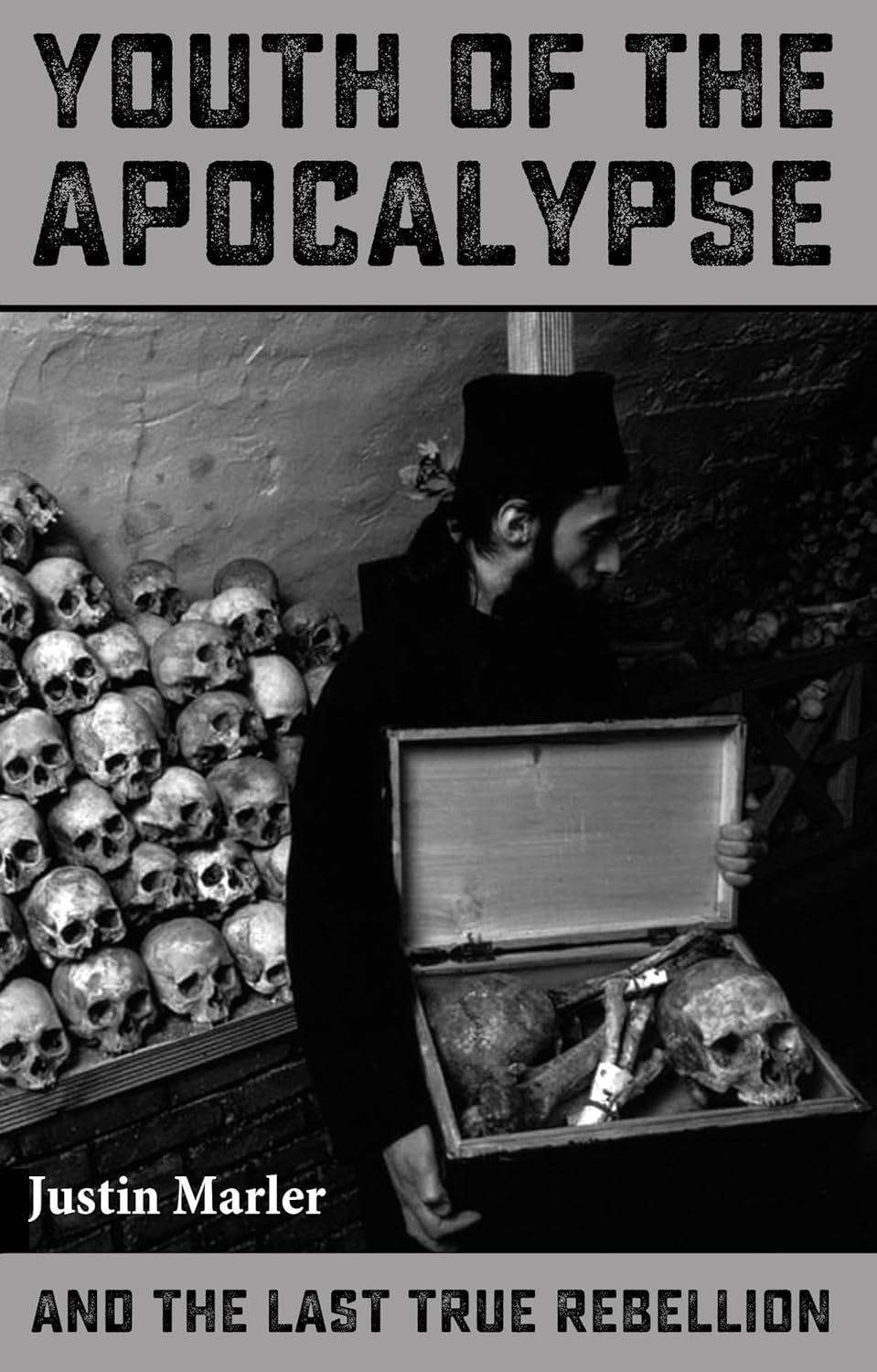

There is a particular loneliness to being young in the modern world that is difficult to explain without sounding melodramatic. Everything is available, everything is connected, everything is instant, and yet beneath the glow of screens and the hum of constant entertainment there is a quiet suspicion that something has gone terribly wrong. Not suddenly, not dramatically, but slowly and thoroughly, like rot spreading beneath polished floorboards. We have inherited a world that calls itself advanced while quietly producing generations that feel lost, anxious, and spiritually homeless.
We are told we are the freest generation to ever exist. We are told we can be anything, pursue anything, indulge anything. Yet beneath this endless permission is a deep exhaustion. It is the exhaustion of people who have been handed everything except a reason to live.
Justin Marler writes, “This is our origin. We have come from thousands of years of sorrows—in hunger, in thirst in nakedness, in imprisonment, and in death. With every step in mankind’s path of evil, man has almost entirely burned the bridge to his Creator. And in place of the Creator, man has enthroned his own imperfect mind and his machine. With this machine mankind has progressed into regression. The machine has proved dysfunctional and is now totally out of control, victimizing everyone in its path, especially the youth of today. All of us, the youth of the Apocalypse, have been caught in the gears of this machine of nihilism.”
The phrase feels severe until you stop and look honestly at the world we inhabit. Never before has humanity possessed so much power, so much convenience, so much instant gratification. We hold the accumulated knowledge of civilization in our hands, summon entertainment in seconds, speak across continents without effort, and yet the emotional landscape of our generation is defined by anxiety, depression, addiction, and a quiet, persistent despair. We are the first generation to carry the entire world in our pockets and still wake up asking why we feel so empty. We have conquered distance, comfort, and boredom, but not meaning. We have solved inconvenience and somehow intensified loneliness.
This did not begin with us, and that is part of the tragedy. We inherited this condition the way children inherit debt they never incurred. The emptiness did not arrive overnight. It crept in quietly as the world traded mystery for efficiency, transcendence for convenience, and truth for personal preference. Each generation shaved away a little more of the sacred until eventually nothing felt sacred at all. What began as small compromises hardened into assumptions. What began as questions became slogans. Until one day we woke up inside a world where meaning felt optional and wonder felt childish, and we called this progress because we had forgotten what we lost.
You can hear the shift most clearly in art and music, because art always reveals the soul of a culture before philosophy catches up. “When looking at the progress of the modern machine towards its end, one can see the writing on the walls in music. Being a popular expression of the people, music is like a litmus test for the state of the culture. Nietzsche’s message of nihilism and death of truth had a curious impact on the famed modern German composer, Richard Wagner, who was also admired by Hitler. In these three pillars of modern destruction we see a philosopher, the ruler and the musician collaborate to de-inspire, to dismantle and destroy.”
The point is not the names. The point is the pattern that repeats through history like a slow drumbeat. Ideas are never harmless. They seep into art, into politics, into education, into the invisible assumptions that shape daily life. When truth becomes negotiable, everything else soon follows. When meaning becomes subjective, nothing remains sacred for long. A civilization can survive hardship, famine, and war, but it cannot survive the loss of meaning without eventually turning against itself. When a culture forgets why life matters, it begins to treat life as disposable.
Today we live in the aftermath of that shift. A generation raised not gradually into technology but submerged in it from birth. Every moment filled, every silence avoided, every discomfort anesthetized. We are constantly stimulated and rarely fulfilled.
“…All have different styles and fashions, but all are wired together by two things: technology and nihilism. Addiction to, and reliance on technology, combined with the philosophical underpinning of a nihilistic worldview has numbed and emptied our souls. It is killing us slowly and invisibly. It’s the Modern Technology generation, which ironically sounds like ‘empty generation.’”
The tragedy is not technology itself. The tragedy is that we have built our emotional lives around it. We scroll when we are bored, scroll when we are sad, scroll when we are lonely, scroll when we are afraid. We have trained ourselves to fear stillness. We have built a world where distraction is always one second away and silence feels threatening. The modern person can endure almost anything except quiet. Yet quiet is where the deepest questions rise, and without those questions, the soul begins to suffocate without ever understanding why.
Silence is where the soul speaks.
We live like survivors wandering through the ruins of a war we never witnessed but somehow lost. We inherit the debris of centuries of spiritual drift and call it normal.
“It’s too easy to say that we, the children of the modern age, are not affected by the history of nihilism, yet we sit in the ashes: abandoned children in a wasteland of apostasy, lonely survivors of centuries of violence with no one to point in the direction of home, for all has been destroyed.”
We feel this even when we cannot explain it. A strange homesickness for a time and place we have never seen. A sense that we are missing a map, missing a compass, missing a direction that once felt obvious to those who came before us. We wander through abundance like refugees. Surrounded by comfort and yet starved for purpose.
“Just as always, it is the children who become the worst victims of war. In this seemingly eternal fight of man against God, childhood innocence has not only been violated and abused, but totally annihilated.”
Look honestly at the emotional landscape of our generation. We are the most entertained people who have ever lived and among the most medicated. We speak openly about anxiety, depression, and despair not because stigma has vanished, but because suffering has become ordinary. Entire industries now exist to manage the emotional fallout of a civilization that has forgotten how to give people a reason to live.
“Self-mutilation is no longer considered a product of mental illness but rather something many desire. Clearly insanity is replacing sanity.”
We are no longer shocked because nothing is allowed to remain hidden. Every taboo is displayed, every boundary tested, every desire marketed. The modern world prides itself on being unshockable, but the absence of shock is not strength. It is numbness. A culture that cannot be shocked has lost the ability to feel reverence.
“The screens in our homes can transport anyone into a brothel in seconds.”
We call this freedom. We call this progress. We call this liberation. But liberation from what? From restraint? From discipline? From responsibility? And toward what exactly? Toward endless consumption, endless stimulation, endless distraction? Freedom without direction is not freedom. It is drift.
Once, innocence was admired. Now innocence is awkward, embarrassing, even suspicious.
“Once, virginity was considered a virtue, but in these twisted times virginity is considered a sign of weakness or something to be ashamed of or embarrassed by.”
The words remain but their meanings invert. Love becomes appetite. Commitment becomes restriction. Discipline becomes repression. Virtue becomes weakness. The vocabulary of the heart survives while the heart itself is quietly hollowed out.
“The truth of love receives its meaning from the perfect love revealed by God. When the notion of God is raped from the minds and hearts of mankind, true love is lost. What is left is a cloak under which man disguises his carnal lust.”
We chase experiences hoping they will fill the quiet ache we cannot name. We experiment, indulge, escape, and distract. We tell ourselves the next pleasure will be the one that satisfies.
“Man’s seeking through drugs is a dream in which he chases shadows. In the end it is an illusion that passes away, leaving the seeker in desolation.”
The shadow always dissolves. The high fades. The distraction ends. The hunger returns, louder than before. Because the hunger was never for pleasure in the first place. It was for meaning, for transcendence, for something that could not be downloaded, consumed, or purchased.
“As a society we now see death as a solution and life as an inconvenience.”
The sentence sounds extreme until you begin listening carefully to the way people speak. Despair is casual. Exhaustion is normal. Escape is framed as relief. Life itself is described as overwhelming, inconvenient, or burdensome. When a culture begins to treat existence as a problem to solve rather than a gift to receive, something has gone terribly wrong.
Religion should be the place we turn for clarity. Instead, modern people often encounter a platter of competing modern spiritualities that feel shallow, commercialized, or confusing.
“This myriad of religions has damaged and confused us, and left us in total apathy, and has left us to say, ‘I’m sorry my karma has run over your dogma!’ So, we no longer lift our heads when the next circus of ‘religion’ passes through our town, but continue to stay downcast.”
And eventually the anger burns out and leaves only apathy. Not rebellion, not conviction, not belief, just exhaustion. Spiritual indifference is the final stage of a civilization that has tried everything except truth.
“If he does not unplug himself, man will plunge headfirst into apathy.”
And here is the quiet turning point.
Because the message is not despair. The message is rebellion. But not the rebellion we have been taught to admire.
The world tells us rebellion means indulgence. Breaking boundaries. Rejecting tradition. Following desire. But what if the real rebellion today is the opposite?
What if the last true rebellion is discipline in an age of indulgence? Silence in an age of noise? Prayer in an age of distraction? Faith in an age of irony?
The modern world tells us to chase what we want. The spiritual life asks us to pursue what we need. At first this feels like loss. Like deprivation. Like swimming against a powerful current. But slowly something changes. The noise begins to fade. The hunger begins to quiet. The restless ache begins to transform into peace.
The world promises happiness through endless consumption. The spiritual life offers something quieter and more enduring. Meaning. Purpose. Direction. Home.
If you ask me, I say Death to the World. Not as a gesture of bitterness, not as an excuse for apathy, and certainly not as a hatred of life itself, but as a rebellion against the quiet tyranny of lust, luxury, pleasure, and endless distraction. The world teaches us to indulge everything and call it freedom. The real rebellion is to refuse. To step back. To unplug. To hunger for what lasts instead of what sparkles. It is no longer daring to sneer at the world. That has become fashionable. The true rebellion is to reject its emptiness and still learn how to love life deeply, gratefully, and without illusion.
The book ends with its final chapter on a path forward, how to heal and our world with it, but I suppose you already know His name…

Emphatically and blatantly true. Thank you for sharing this and parts of your story, Levi!
Oh, this book is clearly calling me, seems like the perfect choice for Lent. Thank You for sharing, brother!
I have found many things that I used to love in the world don’t do it for me anymore, it must be a grace from the Lord, to pull me deeper into himself. I love the peace that enters into past places of hunger. That’s true freedom to me.