
Why Demons Hate Humanity
Envy, repentance, and the destiny angels refused

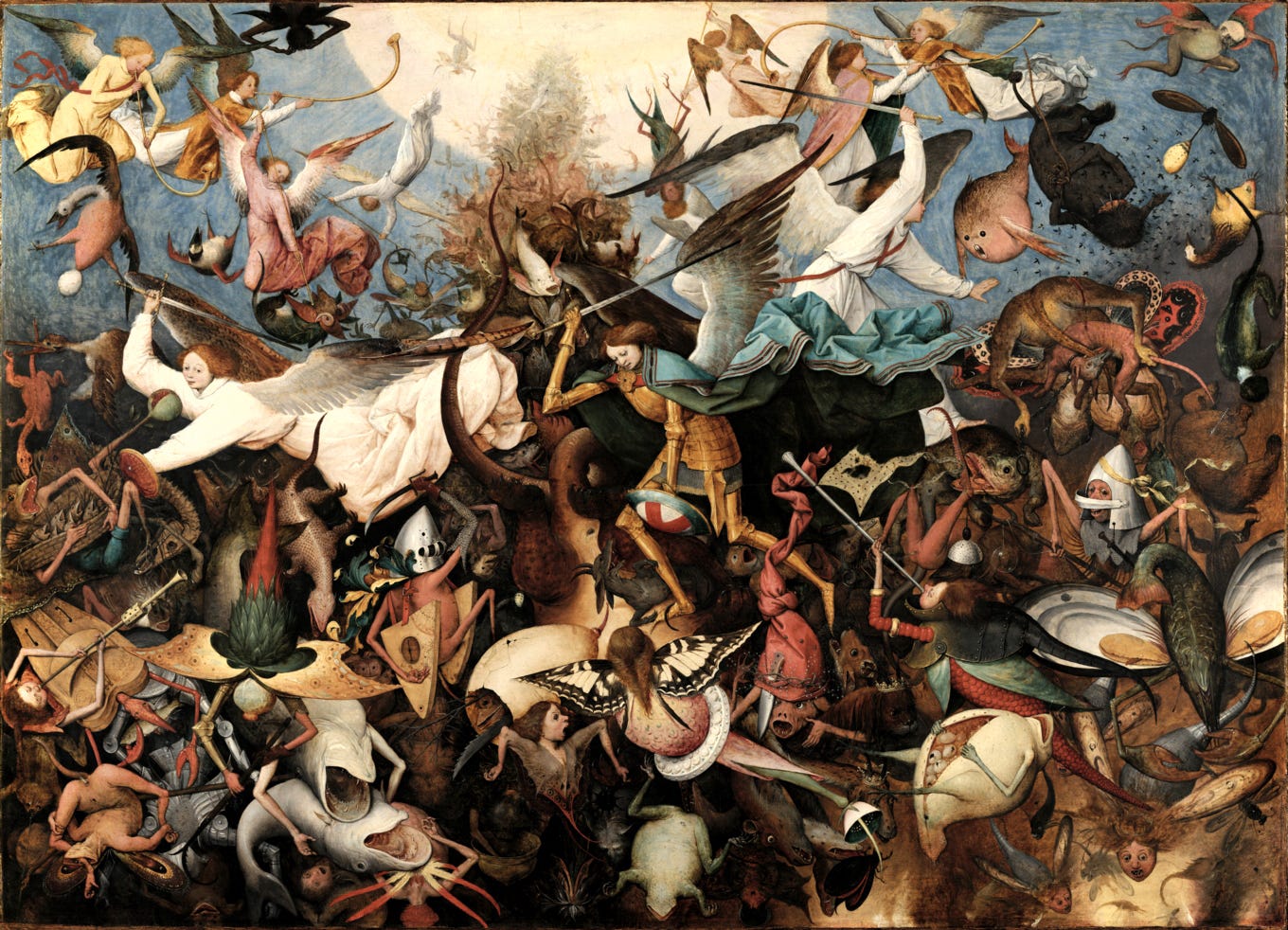

There is an assumption in the modern world that evil is impersonal. We imagine darkness as a vague force, a kind of cold absence, like a room without light. But the Christian tradition has always spoken about evil very differently. It has spoken of it as something personal, something intelligent, something that sees us and hates us.
To many modern ears this sounds medieval or superstitious, but the saints spoke about it with calm certainty. They did not treat demons as symbols of psychology or metaphors for inner conflict. They spoke of them as beings. Ancient beings. Wounded beings. Beings who once knew God and now exist in a state of furious deprivation.
And in the strange, unsettling testimony of the Church Fathers, these beings harbor a particular hatred for humanity.
It is worth asking why.
At first glance the question seems simple. If demons rebelled against God, then it would make sense that they oppose anything God loves. But the Fathers suggest something more specific and more unsettling. Demons do not merely oppose humanity as part of a general rebellion. They envy humanity.
In the ancient Christian understanding of creation, angels and humans were both made by God but with different destinies. Angels were created as spiritual intelligences. They exist in a state of clarity and immediacy that humans cannot yet comprehend. Their perception of truth is not slow and discursive like ours. They do not reason step by step through uncertainty. They see. They know. Their awareness is swift and luminous.
Because of this clarity, their choices are also immediate and complete.
When the angelic rebellion occurred, it was not the kind of confused wandering that humans often experience when they sin. Angels did not fall through ignorance or weakness or gradual temptation. Their rebellion was a direct act of will made in the full light of their knowledge. They saw God clearly and still chose themselves.
This is why the tradition teaches that angels cannot repent.
Repentance belongs to creatures who live inside time and change. Human beings learn slowly. We are born in weakness. We misunderstand. We grow. Our minds develop. We stumble into sin and sometimes awaken to it only later. Our story unfolds step by step across a lifetime.
Because we change, repentance is possible.
Angels do not exist within that slow unfolding. Their choices are immediate and complete. When a human being sins, he may later look back and realize what he has done. A fallen angel has no such discovery. The decision was made with total awareness.
The tragedy is not that God refuses them repentance. The tragedy is that they no longer desire it.
The Fathers sometimes describe the demonic state as a kind of frozen will. They have fixed themselves permanently against God. They exist in a self-chosen exile, aware of what they have lost yet unable to turn back.
And here the story becomes deeply unsettling, because humanity occupies a place in creation that demons cannot bear.
Human beings are weak. We are fragile, mortal creatures of dust. Our minds wander. Our desires pull us in a thousand directions. Our lives are brief and uncertain. Yet within this frailty lies something astonishing.
We are called to become what the demons refused to be.
The Christian doctrine of Theosis teaches that humanity is invited into union with God. Not merely obedience, not merely forgiveness, but participation in divine life. The saints speak of it as becoming by grace what Christ is by nature.
This is not poetic language. It is the final destiny offered to humanity.
The angels were created glorious, but they were not invited into this union in the same way. Humanity was created as a bridge between the material and spiritual worlds. Our bodies belong to the earth, yet our souls are capable of communion with God.
Through the Incarnation this destiny was sealed forever. God did not become an angel. He became a man.
Christ took on human flesh, lived a human life, died a human death, and resurrected human nature itself. In doing so he elevated humanity beyond what angels could have imagined.
The Fathers often say that this is part of what enraged the fallen angels. They saw creatures of dust raised to a place they had rejected.
It is here that their hatred becomes deeply personal.
Every human life represents a possibility the demons destroyed within themselves. Every act of repentance reminds them of a door they slammed shut forever. Every saint who grows radiant with divine grace becomes a living reminder of what they lost.
This is why temptation so often aims at the human mind.
The battleground of spiritual warfare is rarely external. It unfolds quietly within the interior world of thought. The desert fathers understood this with remarkable clarity. They spoke about thoughts arriving like whispers or shadows. Some came from memory. Some came from imagination. Some came from darker sources.
The mind is where the human person directs his life. If the mind becomes confused, the entire person follows.
Demons cannot force a human being to sin. The Fathers are clear about this. They can only suggest, distort, provoke, and deceive. Their power lies in persuasion. They plant thoughts, stir emotions, and attempt to make destructive impulses appear reasonable.
This is why the spiritual life often feels like a struggle over attention. A person does not suddenly wake up one morning and decide to ruin his life. The process begins quietly. A thought appears. The thought lingers. It grows attractive. Eventually it becomes action.
The saints compared this process to sparks landing on dry grass. If the spark is brushed away immediately, nothing happens. If it is allowed to smolder, it can ignite an entire field.
Demons understand the architecture of the human mind because they have been studying it for centuries. They know our fears, our weaknesses, and our pride. They know which memories wound us and which desires tempt us.
But beneath all this manipulation lies something deeper.
Envy.
The demons look upon humanity and see a creature capable of something they cannot experience. We can repent. We can change. We can fall and rise again. A person may spend decades lost in confusion and still turn toward God in a moment of clarity.
The story of salvation is full of such reversals. Criminals become saints. Cowards become martyrs. Skeptics become apostles.
To a fallen angel this must appear almost unbearable. The same God they rejected continues to pursue creatures who stumble and fail endlessly.
There is something scandalous about this mercy.
Human beings are forgiven again and again. Our sins can be washed away. Our lives can be remade. Even the worst among us can become radiant with grace.
The demons cannot experience this transformation. They exist in a state of permanent refusal. Their hatred grows not only from rebellion but from the knowledge that the door of mercy remains open for us.
This is why temptation sometimes feels strangely personal. It is not merely the pressure of circumstance or the weakness of human nature. The saints often sensed an intelligence behind certain temptations, a persistence that felt deliberate.
Yet the tradition also insists that demons are not nearly as powerful as we imagine. Their strength lies in deception, not in authority. They depend upon the cooperation of the human will.
A person who turns toward God with sincerity becomes profoundly difficult for them to influence. The light of humility and prayer confuses them. Acts of forgiveness and mercy disarm them. Repentance weakens their accusations.
The saints often described demons as creatures who grow furious when confronted with humility. Pride is the soil in which they thrive. Humility is the air they cannot breathe.
This reveals something remarkable about the human condition.
The weakest human being, if united to God, stands in a position the demons cannot approach. The most fragile saint becomes a kind of living contradiction to their rebellion.
A human life may appear small from the outside. It unfolds quietly in homes, workplaces, churches, and ordinary moments. Yet from the perspective of eternity it carries immense significance.
Every decision to love, every act of repentance, every prayer whispered in sincerity becomes a movement toward the destiny demons rejected.
This is why spiritual struggle matters so much.
Human life is not merely a biological existence drifting through time. It is a battlefield of eternal consequence. The choices made within the human heart ripple outward into the unseen world.
And this may be the deepest reason demons hate humanity.
We are fragile creatures of dust who have been invited into the very life of God.

Brilliantly expressed.