
When the Churches Burned
What Black Metal Reveals About a World Without God


Once again the problem returns to nihilism.
I have written about it many times before. The slow spiritual disease of the modern world, where belief fades, purpose dissolves, and people are left wandering through a life that feels strangely hollow. A society may still function outwardly. The streets remain clean, the houses warm, the supermarkets full. But beneath that comfortable surface something essential has gone missing. When meaning disappears from a culture, people do not simply become calm and rational. They begin searching for intensity, for myth, for something powerful enough to make them feel alive again.
Sometimes that search leads to beauty. Sometimes it leads somewhere much darker.
In the early 1990s, in a quiet corner of Norway, a group of young men tried to fill that spiritual vacuum with fire, violence, and theatrical evil. What began as a music scene quickly spiraled into something far more disturbing: suicide, murder, burned churches, and a strange fascination with Satan that many of them barely even believed in. The entire movement looked frightening from the outside, yet beneath the corpse paint and blasphemy there was something almost pathetic about it. It was an extreme attempt by a handful of lost young men to feel something in a world that had forgotten how to offer purpose.
What follows is not really a story about music. It is another small chapter in the long and strange history of nihilism.
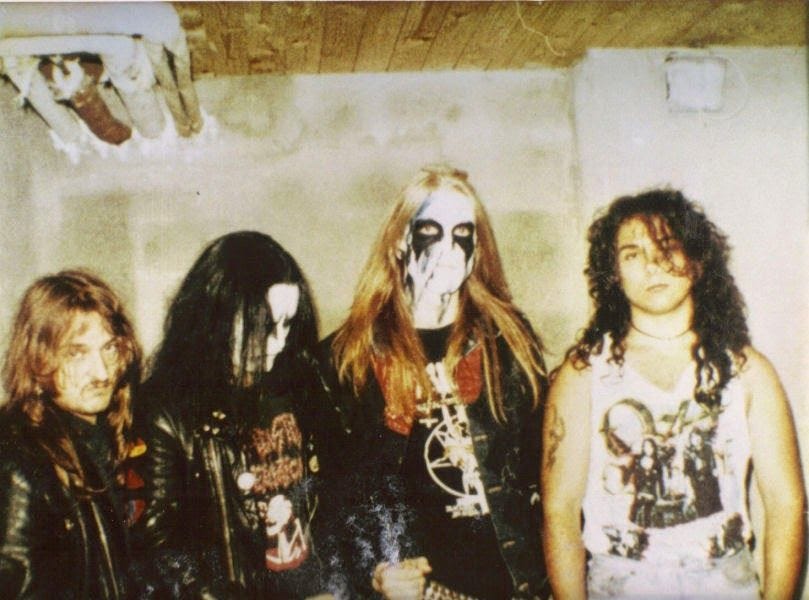
There was a time when I listened to a great deal of black metal. Not casually or in passing, but with the fascination many young men feel when they first encounter something dark, intense, and rebellious. The sound itself felt different from anything else. It was raw and cold, like iron dragged across stone, guitars shrieking like winter wind through broken trees. The imagery that surrounded it seemed equally stark. Musicians painted their faces like corpses and stood in forests or candlelit ruins, singing about Satan, death, frost, pagan gods, and the destruction of Christianity. To someone young and searching for intensity, it felt like stumbling onto a secret world that existed just outside the polite surface of modern life.
In many ways it really was a secret world. The black metal scene that emerged in Norway in the early 1990s was not simply a musical movement. It was an attempt by a small group of young men to construct a mythology out of anger and alienation. Norway at the time was one of the most peaceful and prosperous societies in the world. The country was wealthy, orderly, and deeply secular. Old churches still stood in towns and villages across the landscape, but for many people they had become little more than historical landmarks. The faith that built them had faded into the background of cultural life. A generation had grown up surrounded by comfort and stability but with very little sense of transcendence. In that environment, the absence of struggle began to feel like suffocation.
So a handful of musicians decided that if meaning was not going to be handed to them, they would create it themselves, even if they had to build it out of darkness. They painted their faces like the dead and wrote music that sounded like blizzards tearing across empty mountains. Their lyrics spoke openly about war, paganism, frost, and the destruction of Christianity. They surrounded themselves with symbols that felt ancient and violent, trying to summon something older and more dangerous than the quiet modern world around them. Some of them spoke about the Norse gods. Others embraced the imagery of Satan. Many admitted privately that they did not literally believe in either but were drawn to the force those symbols carried. What those symbols represented above all was defiance. In a society where everything felt safe and neutral, they wanted something absolute.
Yet beneath the theatrics there was a deeper hunger moving quietly through that entire scene. What looked like rebellion on the surface was actually a desperate attempt to recover something sacred in a world that had grown spiritually thin. Human beings cannot live very long without myth or meaning. When faith disappears from public life, people do not simply become calm rational beings who move efficiently through a purely scientific world. Something restless begins to stir inside them. They begin searching for intensity again, for mystery, for symbols that feel powerful enough to shake them awake. The black metal scene was one strange answer to that search. It tried to manufacture a sense of cosmic drama by embracing the darkest images it could find.
The tragedy of that attempt becomes most visible in the story of Per Yngve Ohlin, known in the scene as Dead, the vocalist of the band Mayhem. Even among musicians already dedicated to shocking imagery and morbid themes, Dead stood apart. He did not treat death as an artistic costume. He seemed to live inside it psychologically. Friends described him as quiet and distant, convinced that he had somehow already crossed into the realm of the dead. Before concerts he would bury his clothes in the earth so they would smell like rot when he dug them up. On stage he cut himself with knives and broken glass. His entire presence carried a strange, eerie sincerity. For him the obsession with death was not theatrical.
In 1991 that obsession reached its end when he took his own life. What happened afterward has become one of the most disturbing legends in music history. Euronymous, the guitarist of Mayhem, discovered the body and instead of responding with grief or horror, he photographed the corpse. That image later circulated as the cover of a bootleg album. Stories spread that pieces of Dead’s skull had been fashioned into necklaces and passed among members of the scene as trophies. Whether every detail of that story is perfectly accurate hardly matters now. The fact that it became believable says everything about the atmosphere surrounding that world.
The scene had spent so long romanticizing death that when real death appeared, no one seemed capable of treating it with reverence. Instead it became another symbol, another artifact in the mythology they were constructing. In that moment the aesthetic of nihilism revealed its emptiness. Death, when confronted honestly, is not poetic or dramatic. It is tragic and sacred. But the culture forming around black metal had stripped death of its sacredness and turned it into spectacle.
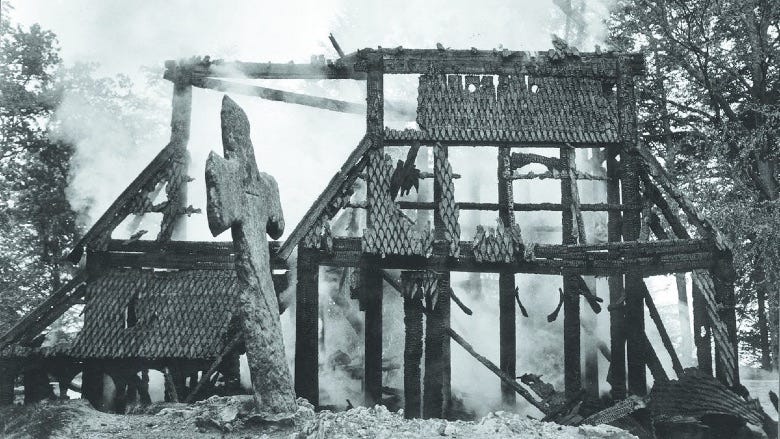
Not long afterward the symbolism began to spill out of music and into the real world. A series of church burnings spread across Norway in the early 1990s, shocking the country and drawing international attention. These were not random buildings. Some of them were medieval stave churches that had stood quietly for centuries, surviving storms, wars, and generations of ordinary believers. Their wooden frames carried the memory of an older Europe where faith shaped daily life. Now they burned in the night as part of what certain musicians described as a war against Christianity.
The violence reached its darkest moment in 1993 when Varg Vikernes, associated with the one-man project Burzum, murdered Euronymous during an escalating conflict within the scene. What had begun as music had turned into something far more unstable. A mythology built on images of hatred, desecration, and destruction had begun to bleed into real human lives. The line between performance and reality had grown dangerously thin.
One of the most revealing aspects of the entire phenomenon is that many of the people involved did not actually believe in Satan in any traditional sense. Some described Satan as nothing more than a symbol of rebellion against Christianity. Others preferred pagan imagery drawn from Norse history. A few admitted that the entire framework was largely theatrical. But symbols are rarely empty, even when people treat them that way. They carry centuries of meaning within them. When someone surrounds himself constantly with images of hatred, death, and blasphemy, those images begin to shape his imagination whether he intends it or not.
What begins as performance slowly becomes identity. Aesthetic rebellion becomes a kind of worldview. In later years bands such as Behemoth and Gorgoroth embraced overt Satanic imagery with increasing intensity. Their performances resembled rituals more than concerts, with elaborate altars, inverted crosses, and proclamations that glorified Satan as a figure of liberation. In some cases the symbolism became strangely ornate, presenting Satan crowned with flowers or enthroned like a dark saint. The rebellion had matured into its own form of worship.
That transformation reveals something profound about human nature. The instinct to worship never truly disappears. When God is removed from the center of the world, something else inevitably takes that place. Sometimes it is political ideology. Sometimes it is technological optimism. Sometimes it is a theatrical celebration of evil itself. But the human heart continues searching for something worthy of reverence, even if it chooses the wrong object.
Looking back at the black metal scene now, what strikes me most is not its darkness but its sadness. These were not powerful revolutionaries overthrowing a religious empire. They were mostly young men who sensed that something sacred had disappeared from the modern world and did not know how to respond to that loss. The churches that stood across Norway represented a faith that once shaped an entire civilization, but to many people they had become little more than historical architecture. In the absence of living belief, the rebellion that followed tried to recreate intensity through destruction.
There is a strange irony hidden inside that rebellion. The very Christianity they tried to attack was the tradition that preserved the cosmic drama they were attempting to imitate. The idea of Satan as the great adversary exists only because of Christianity. Without that story the symbolism collapses. The war they imagined themselves fighting depended entirely on the religious framework they were rejecting.
In the decades since those events, many of the individuals involved have drifted into quieter lives. Some abandoned the ideology entirely. Others remain committed to it in various forms. The fires that once lit the Norwegian countryside have long since gone out. Churches that burned were rebuilt. Villages returned to their ordinary rhythm. The cultural storm that once seemed so dramatic faded into history.
Christianity, the target of all that fury, remains where it has always been. It has survived emperors, revolutions, persecutions, and countless attempts at destruction across two thousand years of history. The black metal rebellion was only one small chapter in that long story.
Yet it remains a revealing chapter because it shows something important about the modern spiritual condition. When belief fades from a culture, the human heart does not become empty and peaceful. It becomes restless. It begins searching again for mystery, myth, and transcendence. Sometimes that search leads people back toward beauty and faith. Other times it leads them into strange imitations of the sacred, where darkness is mistaken for depth and destruction is mistaken for power.
The young men who painted their faces like corpses and sang about burning heaven were not simply villains in an obscure musical subculture. They were symptoms of a deeper hunger moving quietly through the modern world. And hunger, if it is not nourished by something good, will eventually consume whatever darkness lies closest at hand.

Hmm, is this where the (oft misguided) rock/metal = satanic music association came from?
I like to listen to rock and neofolk music, and while they frequently celebrate wild living (in the case of the former) or invoke pagan gods (in the case of the latter), I have never heard one that explicitly hate on God and/or the church.
Still, I can recognize the rage (or lament) against emptiness and desire for transcendence in many of these songs. And in a lot of cases, they seem to deliver. The percussions and instrumentals can tingle the senses and stir the heartbeat in a way that seem to move them with supernatural energy.
I suppose this is why Tolkien's framing of the story of Christ as "True Myth" is more important now than ever. The recognition that many of the pagan myths arise from shared human longing and fears rather than simply deviant nonsense might be the best way to bridge the gap between the people's hunger and the light revealed in Christ.
Sometimes, well-meaning Christians, in their desire to keep the faith pure from syncretism and pagan influences, strips it away from the symbols that tends to make the stories beautiful.
People are still burning churches. My friend was the Episcopal priest at one of these churches https://www.justice.gov/usao-az/pr/douglas-man-who-burned-two-churches-convicted-hate-crimes-and-arson