
The Sweet Wind
A Tale of Flowers and the Forgotten

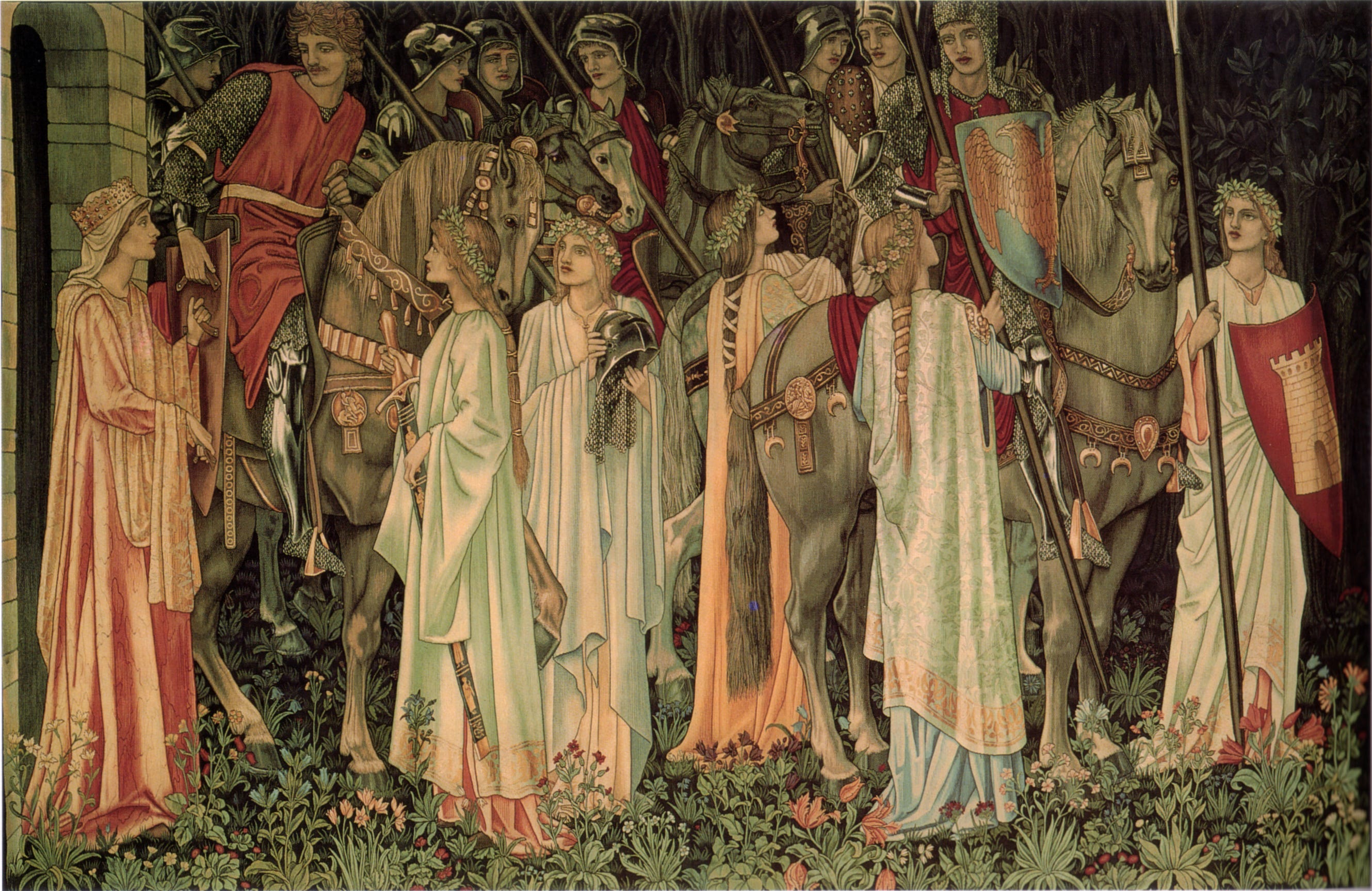
I.
The dead had not yet gathered at Caerwynd’s gates, but everyone on the walls could feel their nearness. It lay in the way the wind hesitated, faltering from its usual sweet course. Birds had stopped roosting on the rafters and steeples. The flower-keepers whispered more quietly than usual, glancing often toward the valleys.
Sir Corin of the Garlanded Order stood watch above the eastern battlements, the cold stone pressing through his greaves. His armor was wrapped in woven strands of dried lavender, hyssop, basil, and crushed marigold: the greatest protection a knight of Caerwynd could wear. They called him a Flower-Knight, though he sometimes felt more like a walking herb bundle than a soldier. Blossoms dangled from his pauldrons and rustled when he breathed.
Today he noticed how many had wilted.
He plucked a petal from his chest-garland—once bright blue, now the color of old bone—and let it fall. The wind carried it only a moment before it dropped lifelessly over the wall.
Winter had come too early.
And early winters always carried the dead.
Below him, the roofs of Caerwynd bloomed in carefully tended gardens. Every home had its perfumed thatch. Every balcony dripped with herbs. Every alley was scrubbed with mint-water or scattered with petals. The city glowed with color even in the pale winter light, a desperate defiance against the rot spreading beyond the walls.
But the sweet scent that protected them was fading. Corin felt it like a tightening in his ribs.
Behind him came the uneven steps of Brother Odo. The monk always walked as if burdened by too many books. Today he clutched a rolled parchment to his chest, the ink still damp.
“Sir Corin,” he said, adjusting his spectacles. “How fare the garlands?”
Corin lifted his arm. A small cascade of brittle petals drifted down.
Odo grimaced. “God preserve us. Even the basil is browning. We’re not meant to see frost like this until deep winter.”
“Tell that to the wind,” Corin murmured.
Odo leaned over the battlement. In the valley beyond, fog curled like ghost-breath across the dead fields where no flowers grew, only cracked earth and the hush of rot. Somewhere beneath that fog lay abandoned villages, plague-pits, and graves where corpses had not been carefully tended.
Corin had fought in those places. He knew how the dead rose—not with shrieks or sorcery, but quietly, as if standing from sleep.
“Do you smell it?” Odo asked.
“What?”
“The lack,” he said. “The absence of sweetness. As if the world itself has forgotten spring.”
Corin inhaled. Even through his garlands he could smell it now: the faint sour rot of frostbitten earth. The absence of fragrance was more dangerous than stench. Stench meant something was still alive enough to decay. Absence meant life had already given up.
A cry rose from below.
“Captain on the wall!”
Dame Senne climbed the stairs two at a time, her armor creaking under the weight of the garlands wrapped thick around her arms and waist. Unlike Corin’s, hers were still mostly fresh. She replaced them obsessively, sometimes several times a day, insisting it kept her as sharp as a blade.
Her hair was braided with violets. Her gauntlets smelled of rosemary oil. Her expression was hard.
“We’ve sighted movement in the valley,” she said.
Corin stiffened. “The dead?”
“Not yet,” she replied, though the tension in her jaw said she feared otherwise. “But the flower-keepers feel a shift. Alina says the hyssop atop the western wall mottled brown overnight. That shouldn’t happen unless—”
“Unless the dead are drawing near,” Odo finished.
Senne nodded. “Father Grent is preparing the prayers. Light the honey-braziers at dusk.”
Corin hesitated. “It feels too soon. There were no signs yesterday.”
“Frost is sign enough,” she said. “A winter like this starves the gardens. Starved gardens mean thin fragrance. Thin fragrance draws the dead.”
A young woman climbed up behind her: Alina, one of the flower guild’s apprentices. Her hands were stained with crushed petals and soil. Bits of rosemary clung to her sleeves.
She bowed slightly. “Sir Corin. Dame Senne. Brother Odo.”
Corin nodded. “What news from the gardens?”
Alina stepped forward and held out a small wrapped bundle. Corin unfolded it. Inside lay three blossoms, shriveled to dust, and one that was not wilted but blackened.
“I found it on the abbey roof,” she said quietly. “It died in the night. No frost touched it.”
Odo inhaled. “Blackened flowers mean sorrow-gathering. The dead pull on the places where despair settles.”
Corin looked at her. “Whose roof?”
Alina lowered her eyes. “Widow Marrit’s.”
Silence crept across the wall. Widow Marrit had lost all three sons in last spring’s frost tide. She had barely spoken since.
Senne muttered a curse. “Despair draws them as surely as rot.”
Corin gazed over the valley. Fog rolled heavily. A darker shape moved far off, something tall and slow.
“Light the braziers,” he said. “Now.”
Torch-bearers hurried along the battlements. Alina tugged at Corin’s sleeve.
“There’s something else,” she whispered. “In the western garden, the lilies turned their faces east this morning. They never face east.”
“Why does that matter?” he asked.
“The lilies always turn to the sweet wind.”
A tightness crept into Corin’s stomach.
He turned toward the east, the direction of the bleak valleys and the fields where nothing living grew.
The wind shifted again.
It blew from the east.
Cold. Empty.
And somewhere far out in the fog, a lone figure straightened from the earth and began to walk toward Caerwynd.
The first of many.
II.
By morning, the valley held five walking dead instead of one.
Sir Corin counted them from the eastern wall as the sun tried and failed to rise above the gray line of distant hills. The light could not break through the clouded winter sky; the day arrived as a dim, cold smear. In that faint half-light, the dead looked like figures carved from soot and frost, wandering slowly but steadily toward the city.
They never rushed.
They never ran.
They simply came.
Behind Corin, flower-keepers hurried up and down the battlements, replacing garlands, scattering petals, feeding the honey-braziers that filled the air with fragrant smoke. But the smoke thinned too quickly. It carried no warmth. Even the scent seemed brittle — as if afraid to linger.
Winter’s grip deepened by the hour.
Dame Senne arrived beside him, armor clinking softly beneath her fresh wreaths. “There are more in the trees,” she said. “Alina spotted four shapes near the alder grove.”
Corin exhaled. “They gather faster this time.”
“They can sense it,” she replied. “The gardens are failing.”
A bell rang below, slow and heavy, calling the flower guilds together. The people of Caerwynd moved like shadows across the courtyards, pulling cloaks tight, clutching bundles of herbs and pots of oil. Even their breath formed gray clouds, rising and vanishing like prayers lost to the wind.
Brother Odo approached with Father Grent, their robes layered with dried blossoms that rustled against the wool. Grent’s expression was stern, but his eyes betrayed unease.
“We should hold a vigil tonight,” Grent said. “The people must be reminded that God has not abandoned us. These are trials, nothing more.”
“They are trials that claw at the walls,” Odo murmured.
Grent frowned. “Faith must come before fear, Brother.”
“Faith thrives best when fear is understood,” Odo replied.
Corin stepped between them. “Has the council gathered?”
Grent lifted his chin. “Yes. They wait in the Abbey Hall.”
Inside the Abbey Hall, warmth lingered in the stones from decades of stored sunlight. Even so, the air smelled faintly of withering sage. Around the table sat the elders of the flower guild, the garrison commanders, and the abbey’s clergy.
Alina stood near the wall, hands clasped around a sprig of rosemary for steadiness. She looked pale — exhausted, though she tried to hide it.
Guildmistress Helya rose first. “Winter has taken half our gardens. The frost this year is deeper than any we have records of. If the flowers continue to die, our fragrance-barrier will fail entirely.”
Murmurs rose around the hall. Corin remained still. He knew the truth already. The dead only gathered when the gardens faltered.
Helya continued. “We have one hope: the Everbloom.”
The room shifted. Even Grent’s brows lifted.
Corin exchanged a glance with Senne. The Everbloom was a rumor — a fireside story travelers shared on long winter roads.
“A flower that survives winter?” Grent scoffed. “A fable.”
“It is no fable,” Helya said. She gestured to Brother Odo, who unrolled the parchment he carried. “The monk has found references in the old cloister records.”
Odo placed it on the table. The parchment showed the stylized drawing of a pale flower with long curling petals growing against snow.
“This depiction appears in the margins of three different manuscripts,” Odo said. “All from the southern cloister of Saint Perrin.”
Corin frowned. “That cloister was abandoned during the plague.”
“Abandoned, not destroyed,” Odo answered. “Its gardens may yet hold the seeds.”
Senne tapped the hilt of her sword. “The cloister lies nearly seven days’ travel from here. Through plague villages. Frozen woods. And now the dead gather faster each day.”
“We need those seeds,” Helya said. “If the Everbloom lives — even as a memory — it could restore fragrance to our defenses.”
Father Grent folded his arms. “You speak of trusting flowers more than trusting God.”
“And who gave the flowers their scent?” Helya asked. “Who gave us hands to tend them?”
Silence followed.
Then Corin spoke. “Send a company. I will go.”
Senne stepped forward. “As will I. Choose three more, and we leave by dusk.”
Odo raised a hand. “You’ll need me. Someone must identify the true Everbloom if it’s there at all.”
Alina looked up from her rosemary sprig. “Then take me too.”
Corin hesitated. “Alina, the roads will be dangerous. The dead gather on them first.”
“I know,” she said, voice steady. “But I can feel when a garden sickens. I know the signs before others do. If the Everbloom is there, I will recognize it.”
Helya gave a single approving nod. “She speaks truth.”
Corin studied the girl. Young, yes, but her hands carried the stillness of someone who had tended life her whole life. They needed that.
“Very well,” Corin said. “You join us.”
Father Grent scowled. “An apprentice girl, on a journey like this?”
“Faith is not bound to age,” Odo said.
Nor is courage, Corin thought.
Senne tightened her gauntlet strap. “We leave before sundown.”
The council dispersed. Helya embraced Alina and hurried off to prepare dried bundles of herbs. Grent muttered prayers. Odo packed ink and parchment with shaking hands. Senne marched off to gather weapons and fresh garlands.
Corin walked to the doorway, cold air seeping in around the frame. Beyond the courtyard, bells sounded again — warning of new shapes on the horizon.
“Sir Corin?” Alina’s voice reached him softly. “Before we go… the lilies faced east again this morning.”
He nodded slowly. “Then the sweet wind is failing.”
Alina held the rosemary sprig as if it were a charm against winter. “We must find the Everbloom.”
Corin looked toward the valley, where the dead now moved in deliberate numbers.
“We will.”
He hoped he spoke truth.
That evening, as the sun vanished behind bruised clouds and the dead crossed the final stretch of frostbitten valley, five figures slipped through the postern gate of Caerwynd. Their cloaks were lined with petals, their swords wrapped in fresh garlands. Hope and dread weighed equally in their steps.
Sir Corin led the company into the gathering dark, the cold wind biting at their heels.
Behind them, the bells tolling from Caerwynd’s walls sounded like the beginning of a long night.
III.
They traveled under a sky the color of hammered lead, the cold tightening with every mile south. Frost clung to the bare branches of beech and alder, turning them ghost-pale. The company’s garlands provided a little comfort, scattering small pockets of fragrance into the air, but even those seemed to thin more quickly than normal. Winter pressed its weight on everything.
The road left Caerwynd’s valley and wound through rolling fields where summer wheat had once grown tall. Now the ground was pocked with old plague pits, half-sunken into the earth like the dimples of giant fingers. They passed them quietly. Everyone knew better than to linger where bodies had not been tended.
Alina walked near Corin, clutching a bundle of dried sage and mint. Her face was pale but focused, eyes always scanning the hedgerows and gullies as if listening for something beneath the soil.
“Do you feel anything?” Corin asked her as they marched.
She hesitated. “Not yet… but the air is heavy. The flowers back home were right to turn east. Whatever is shifting out there, it’s spreading.”
Brother Odo joined them, his breath forming small clouds. “The manuscripts speak of places where the veil between life and death thins,” he said. “Fields where abandonment took root. Villages left to rot.”
Corin glanced ahead at Senne, who led the column with one hand always resting on her sword. Behind her came Tomas the archer, and Brannoc, a young soldier selected for his steady nerves and his skill with a morningstar.
“Do not speak of veils,” Corin said quietly. “These lands have known enough sorrow.”
“Which is precisely why the dead rise here,” Odo replied. “Neglect is its own summons.”
They walked until dusk. The sun never broke the clouds, but its dimming was enough to signal the cold drop that always followed. Senne raised her hand, and they halted near a stand of twisted hazel trees.
“We make camp here,” she said. “Keep the brazier burning through the night.”
She and Brannoc set about gathering dry brush, while Tomas cleared a small circle in the frost-bitten grass. Corin helped Odo unpack the small copper brazier, dented and soot-blackened from years of use. Alina prepared the herbs, crushing rosemary and sweetgrass between her palms before scattering them over the coals.
The fragrance rose slowly at first, then in a soft wave that warmed their lungs and eased the tension from their shoulders. It smelled like Caerwynd. Like safety.
They ate in silence: hard bread, dried berries, and a small heel of cheese. The quiet was comforting at first. Then the woods began to settle into their night sounds — branches creaking, frost shifting across the ground, the distant hoot of an owl.
Brannoc stared into the darkness between the trees. “Feels wrong out here,” he muttered. “Too still.”
Senne nodded. “Winter stillness is common. This is something else.”
Odo poked at the brazier. “Something is drawing the warmth downward. The air sinks too quickly.”
Alina looked across the frost at the empty fields. “It sinks toward sorrow.”
Corin turned to her. “How do you know?”
“I don’t,” she said softly. “I just feel it.”
He believed her.
They took turns keeping watch. Corin had the second shift. He wrapped his cloak tighter and paced the perimeter while the others slept. The brazier’s fragrance curled upward into the night in slow, steady tendrils.
Hours passed quietly.
Then something moved.
Corin’s hand went straight to his sword. He narrowed his eyes at the hazel trees, searching the shadows for whatever had broken the silence. His heart beat faster, steady and alert.
Not a footstep.
A rustle.
Something low.
He approached carefully.
The shape emerged from behind the roots of a tree — small, half-buried, and shivering.
Corin lowered his sword when he saw it was a boy. Barefoot. Wrapped in a ragged shirt. His breath puffed weakly in the cold. His skin had the pallor of someone who had lived with hunger too long, and dirt streaked his cheeks.
Corin knelt beside him. “Easy, lad. Where is your family?”
The boy didn’t answer at first. He stared past Corin, toward the faint glow of the brazier.
“They’re gone,” he whispered.
Corin felt a slow ache settle into his chest. “Gone where?”
The boy shook his head. “The cold took them. A long time ago.”
Senne joined them, sword drawn but held low. “He’ll freeze out here.”
Alina hurried close behind her. “Bring him to the fire.”
Corin scooped the boy gently into his arms. As he lifted him, the boy trembled violently, clinging to Corin’s cloak with thin fingers.
Back at the camp, Odo crouched by the brazier as Corin laid the boy beside it. Alina offered her cloak, wrapping it around him.
Brannoc frowned. “Why would a child survive alone in this frost?”
Odo glanced at Alina. “Neglected places make strange survivors.”
The boy looked up, eyes huge and glassy. “They’re coming.”
Corin felt a chill deeper than the cold pierce his spine. “Who is?”
“The ones who rise,” the boy whispered.
A moment passed.
Another.
Silence deepened.
Then, far across the fields, something stirred — a faint shuffling, like many feet brushing frost. Tomas sprang to his feet, arrow already nocked.
“There,” he said sharply. “Shapes by the ridge.”
Corin rose, drawing his sword. “Wake the others. Pack quickly.”
Senne moved fast, issuing orders. Odo secured the parchment and herbs. Brannoc dumped sand over the brazier to smother the flame. Alina helped the boy stand, holding him steady.
The shuffling grew louder.
Corin saw them now: a small cluster of the dead moving over the rise, their bodies stiff and pale, their movements slow but certain. More figures followed behind them, and more behind those.
A tide gathering.
Senne cursed. “They shouldn’t be this far south.”
“They’re drawn to the boy,” Odo said quietly.
Alina stiffened. “Why him?”
Corin turned toward the child, noticing for the first time the way his eyes drifted to the earth rather than the sky. His shoulders curled inward, as if bracing for a blow that never came. Something in his posture ached with loneliness.
He had not been tended.
The undead sensed that like wolves scenting blood.
“Move,” Corin said, voice tightening. “Now.”
They fled into the trees with the boy held between Alina and Brannoc. The dead followed, slow but relentless, their footsteps cracking frost as they came.
Corin looked back once.
Only once.
Enough to see the first of the dead tilt its head upward, sniffing the air, following the faintest thread of despair.
Then it continued walking, straight toward their path.
IV.
They did not stop running until the trees thickened into a tangled wood, the branches low enough to claw at their cloaks and the frost deep enough that every step cracked like splintering glass. When Senne finally called a halt, everyone collapsed into a crouch or leaned against trunks slick with winter damp.
The boy clung to Alina’s arm. His breath came thin and shallow, like someone afraid to take up too much space in the world.
Corin scanned the dark between the trees. “Do they follow?”
Tomas, crouched on a low branch, squinted into the frost-fog. “Not yet. They move slow. But they don’t stop.”
“They won’t,” Odo added quietly. “Not while he is with us.”
Alina pulled the boy closer. “We can’t leave him.”
“No one suggested we should,” Corin said, though the truth pressed on him. The dead drew to sorrow as surely as to stench. They would not let the boy go easily.
Senne pointed ahead, deeper into the gloom. “A stream runs through here. Past it, the pilgrims’ road. If Saint Perrin’s cloister still stands, it will be further south along that path.”
Corin nodded. “Move.”
They crossed the stream by hopping stone to stone, their breaths fogging the air, the boy nearly stumbling into the water before Alina steadied him. Brannoc lifted him onto his shoulders after that, and the child rested his chin against the young soldier’s head as if trying to disappear into the warmth.
By midday the trees thinned, and the road appeared: little more than a frost-buried trail lined with the stumps of old guideposts. Snowflakes drifted from the low gray sky. The wind shifted southward and carried with it a faint scent of something unfamiliar.
Not rot.
Not frost.
Something like warmth trying to remember itself.
Alina inhaled sharply. “Do you smell that?”
Odo paused behind her. “I do. Faint as a dying candleflame.”
“What is it?” Tomas asked.
Alina didn’t answer at first. She tilted her head toward the wind as if listening to an old friend. “Life,” she whispered. “Something living.”
Corin followed her gaze down the pilgrims’ road.
There, far ahead, a shape rose against the winter horizon: a cluster of stone buildings, rooflines softened by snow, and a bell tower leaning slightly to one side. Smoke drifted faintly from a chimney. Not black or gray, but thin and white.
Not the smoke of burning bodies.
Not plague-smoke.
The smoke of a living fire.
Corin felt hope stir, tentative and fragile. “The cloister.”
As they approached, the scent grew clearer. It reminded Corin of Caerwynd in springtime: rosemary warmed by the sun, crushed mint underfoot, something sweet beneath it all. The wind itself seemed kinder here, as if softened by its passage over tended earth.
The cloister’s outer gate lay ajar. They pushed it open and entered a courtyard blanketed in snow. Flowerbeds slept beneath the frost, and stone pilgrims’ benches curved in gentle arcs around a dry fountain. The place was quiet. Still. Peaceful in a way that felt almost foreign after days of running.
Odo knelt in the snow beside a bare rosebush. “These were tended,” he murmured. “Recently. Look how the canes have been trimmed.”
Alina walked ahead, brows knitting, her boots leaving careful prints. “Someone lives here.”
Brannoc shifted the boy on his shoulder. “But who?”
A soft cough answered from the cloister doorway.
An old man stood there, leaning on a wooden broom. He was wrapped in a moth-eaten brown robe, his beard long and white, and his eyes bright despite the winter age carved into his face. A wreath of dried hyssop hung around his neck. His presence carried the quiet steadiness of a candle that refuses to go out.
“Welcome,” he said. “You look like wanderers who have come very far.”
Senne stepped forward, hand on her sword but not drawing it. “Are you the last monk of Saint Perrin?”
The old man smiled gently. “The last? Perhaps. I prefer to think of myself as the one still sweeping.”
Odo bowed deeply. “Brother, we seek the Everbloom.”
The monk’s eyes softened. “Of course you do. Winter has grown teeth this year.”
Alina stepped closer. “Does it truly exist?”
“Oh, child,” the monk said, “all flowers exist until they are forgotten.”
He beckoned them inside.
The cloister interior was warm. A small fire burned in a stone hearth. Garlands hung from the rafters in delicate loops. Though many of the monks’ cells were empty and dust-covered, the main hall felt alive. Someone had swept the floors. Someone had tended the hearth. Someone had watered the herbs growing in clay pots along the window sills.
Corin felt a strange ache in his chest. The place was serene in its loneliness.
The old monk led them to a narrow side room with a single long table. Upon it lay a wooden box carved with vines and lilies. The monk opened it with slow, reverent hands.
Inside were seeds.
Small. Pale.
Glowing faintly with an inner warmth.
The air changed the moment the box opened. The fragrance lifted like a memory of summer.
Alina’s breath caught. “It’s real.”
“The Everbloom,” Odo whispered.
Corin stepped forward. “How did it survive the plague? And the winters since?”
The monk rested a hand on the table. “Because we tended our dead. Every one of them. Even when plague emptied our ranks. Even when frost felled the gardens. We never stopped caring.”
He looked at the boy, who shrank behind Brannoc.
“The dead do not rise where love lingers,” the monk said softly. “They rise where things are left alone in their sorrow.”
A heavy silence filled the room. Corin felt its truth settle over his heart like a blanket both warm and cold.
“We came for the seeds,” Senne said quietly. “Our city is losing its gardens. Winter kills faster than we can replace them. The dead gather at our walls.”
The monk nodded. “I will give them to you. But understand this: the Everbloom is not magic. It is memory.” He closed the box and pushed it toward Corin. “Plant them with care. Let no heart in your city be forgotten. Tend all things.”
His voice trembled slightly, but not from fear.
“My time is ending,” he said. “I have kept watch long enough.”
Before anyone could speak, he sat down on a low stool and folded his hands in his lap. The quiet in the room deepened.
Alina stepped forward. “Brother?”
The monk smiled. “Do not grieve. Tending has its rest.”
He exhaled once.
And then he was still.
For a long moment, no one breathed. Corin watched, waiting for some sign, some twitch of rising. But the monk’s face remained peaceful. His hands stayed folded. His body stayed at rest.
Alina’s voice was barely above a whisper. “He… won’t rise.”
“No,” Odo said softly. “He was tended. His sorrow was tended. His life was tended. Death has no claim over him.”
Corin closed the monk’s eyes and bowed his head.
Outside, for the first time in days, the wind carried a faint sweetness.
A promise.
A reminder.
A beginning.
V.
They left the Cloister of Sweet Mercy the next morning beneath a sky still iron-gray, but the wind carried a faint warmth that hadn’t been present in days. It brushed through the trees with a soft murmur, stirring the herb garlands tied to their cloaks. Even Brannoc noticed it.
“Feels like spring remembered us,” he said, adjusting the boy on his back.
Alina nodded, her fingers curled protectively around the wooden box of Everbloom seeds. “This wind won’t last long,” she murmured. “But it wants to.”
Odo tightened the straps of his satchel. “That monk held back despair alone for years. His passing released whatever hope he tended. We should walk quickly while the air remembers him.”
Senne led them along the pilgrims’ road, every step steady and silent. Even Tomas seemed vigilant in a calmer way, his bow lowered but never unstrung.
It wasn’t until midday that the wind shifted.
Only slightly.
But it was enough.
Alina’s breath hitched. “Stop.”
Corin halted immediately. “What is it?”
She pressed her hand to the frost-covered ground, closing her eyes. “Something is wrong. The sweetness is thinning already.”
Odo frowned. “The cloister’s memory can’t reach this far.”
A lonely crow cawed overhead, a black speck against the blank sky.
Senne touched the hilt of her sword. “Eyes up. Everyone.”
Corin scanned the far treeline. For several minutes there was nothing but the stillness of winter. Then Tomas whispered sharply.
“Movement.”
Shapes emerged at the ridge in the distance. Not many. Perhaps a dozen. Their silhouettes were stiff and heavy, swaying like trees in windless air.
Corin felt a knot tighten in his stomach. “They tracked us.”
Odo shook his head. “Not us. Him.” He motioned to the boy.
The child stared at the approaching forms with an expression that was neither fear nor understanding, only a quiet resignation.
Alina knelt before him. “Listen to me. You’re safe. They cannot have you.”
The boy didn’t respond; he simply clutched the edge of Brannoc’s cloak.
Senne exhaled sharply. “We keep moving. Now.”
They pressed on, faster this time. The wind struggled to maintain its sweet undercurrent, but by afternoon the fragrance had faded entirely. The world grew heavier again, colder, as if the memory of the cloister’s warmth had thinned like breath on glass.
Near sundown, they reached the old orchard.
The place had once belonged to pilgrims on the road, back when orchards fed travelers instead of frightening them. But now the trees stood twisted and bare, their fruit long fallen and rotted. Frost clung to the branches like white moss. The ground was uneven, riddled with shallow pits.
Tomas hissed. “Not here. This place is ill.”
“We need cover,” Senne said. “The dead are gaining.”
True enough, the shuffling behind them had grown louder.
Corin scanned the orchard. “There. The presshouse.”
A squat stone building stood half-collapsed at the far end of the orchard. Its roof had fallen inward in places, but the front wall held. A narrow doorway gaped open.
They entered quickly. Inside, old barrels lay smashed and overturned. The air smelled of stale apples and cold stone.
Brannoc set the boy down carefully. Alina knelt beside him with water and a bit of bread.
Senne positioned Tomas by the door. “Count them as they come.”
Tomas nodded. “I see eight. No—nine.”
Corin drew his sword. “We hold until they pass. Quiet. No fear if we can help it.”
Odo stood beside him, clutching a sprig of dry sage between his fingers.
“Fear is a scent too,” he whispered.
The dead reached the orchard a few moments later. Their footsteps spread across the frozen ground in uneven echoes. Corin held his breath as the first figure shuffled between the trees.
It was a woman.
Or had been.
Her gown was torn at the hem, her hair matted with frost. Her face was slack and pale, eyes unfocused, her lips tinged blue. She moved without purpose except the faint, instinctive pull toward the presshouse.
Senne raised her blade — but Corin put out a hand.
“No sound,” he mouthed.
The dead woman drifted closer, head angling slowly like a dog scenting something in the air. Then she paused. Turned. Moved away again.
But the next ones did not.
They came straight toward the building.
Tomas whispered hoarsely, “Three more.”
Alina pressed the boy’s head gently into her shoulder. “Don’t look. Don’t listen.”
Brannoc tightened his grip on his morningstar. His knuckles whitened.
Then a sudden gasp rose from Odo.
Corin turned sharply. “What?”
Odo was staring at the ground near the collapsed section of wall. Frost had melted in a perfect circle around a dark shape buried half in the soil.
A grave.
Shallow.
Neglected.
“Whoever lived here,” Odo said softly, “was not tended.”
The realization sank like a stone.
The dead outside were not drawn to the boy or the company.
They were drawn to this.
The orchard.
The presshouse.
The forgotten grave.
A pounding began at the doorway. Slow, rhythmic, heavy.
Senne gritted her teeth. “They sensed it.”
Tomas backed away from the entrance. “Two at the door.”
Corin stepped forward. “We make no sound. They cannot break the stone.”
Then, from behind them, came a sound that froze every breath:
A hand thrust up from the earth inside the presshouse.
Pale fingers clawed through the frost-softened soil.
The neglected corpse beneath the floor was rising.
Alina cried out before she could stop herself. The boy whimpered and clung to her tunic.
The dead outside began to pound harder, stirred by the noise.
Corin shouted now, no longer caring for quiet. “Brannoc! Hold the door!”
Brannoc slammed his shoulder against the wood, teeth gritted. Tomas and Senne rushed to help.
Corin turned toward the rising shape. It dragged itself upward in jerks, soil spilling off its shoulders. Its ribs showed through its thin skin. Its eyes were sunken hollows. Its jaw hung loose, swaying as it lurched into the dim light.
“Step back!” Corin barked.
Odo gripped his sage sprig and whispered a prayer.
Alina held the boy behind her, trembling but refusing to let go of the wooden box with the Everbloom seeds.
Corin raised his sword.
The corpse took one full, stumbling step forward — then another — then lunged.
Corin swung. The blade cut cleanly, sending the creature to the ground.
But the dead outside hammered harder on the door, the wood bowing.
Senne shouted, “They’ll break through!”
Alina suddenly stood tall.
“Stop,” she said, voice rising above the chaos. “The seeds. They’re warm. They’re—”
She opened the box a fraction.
A soft glow spilled into the darkness, washing over the presshouse like dawn breaking through storm clouds. The fragrance was immediate — strong, sweet, almost unbearably alive.
The dead outside went silent.
The pounding ceased.
Tomas whispered, “Saints…”
Corin stared. The dead at the door had stopped mid-motion. One had its hand raised, as if frozen in place. Another leaned forward, head tilted, unmoving.
Senne exhaled shakily. “It… it halted them.”
Odo wiped his tears with the sleeve of his robe. “Life pushes back death. Even faintly.”
Alina closed the box slowly, carefully, as if handling a living heart.
And the silence that followed was thick, breathless, and trembling.
Corin listened.
The dead outside began to move again — but slower, weaker.
Then they began to drift away.
One by one.
Into the orchard.
Back into the cold.
The company remained frozen in place long after the last shuffling footfall faded.
Finally, Corin sheathed his sword. His hands shook.
“We leave,” he said. “Now. Before the wind changes again.”
Outside, the orchard held its breath.
Behind them, the grave they had disturbed closed itself with a soft sigh of falling frost.
The world was quiet again — but no one trusted that quiet.
They walked through the orchard with the boy between them, Alina’s box held close, the seeds inside still warm.
For the first time, Corin realized just how heavy the weight of hope could be.
VI.
Night fell before they reached the valley road leading back into Caerwynd. The sky darkened to a deep slate, the kind of lightless winter evening where sound carried for miles and every breath seemed too loud.
Corin pushed the pace. “We need the walls in sight before dawn.”
“It won’t happen,” Senne said quietly. “Not with the boy. Not with the cold.”
The boy leaned heavier against Brannoc, exhaustion pulling at his limbs. Alina hovered near him, offering bits of dried fruit and whispering small comforts that seemed to calm him even when nothing else could.
The wind blew colder.
And the sweetness—the faint, lingering memory of the cloister—thinned until it vanished entirely.
Odo drew closer to Corin, his voice low. “If they tracked us through the orchard… they will track us here.”
“They will,” Corin replied. “But we keep moving.”
Tomas scanned the treeline with constant tension in his jaw. “Shapes in the distance. Could be deer. Could be worse.”
In the last stretch of dusk, the dead began to gather again.
The first shuffling shape appeared at the crest of a rise. Then another. Then more.
Corin cursed under his breath. “Not now. Not this close.”
Alina clutched the Everbloom box to her chest. “Should I open it again?”
“Wait,” Senne said sharply. “Not here.”
“Why not?” Tomas asked.
Senne motioned toward the enormous frost-covered boulder at the side of the road. The crack along its base was stained with dark earth—old earth.
“A grave,” Odo whispered. “A forgotten one.”
Corin’s heart sank.
The Everbloom’s light might slow the dead, but if awakened near a grave… it could stir something worse.
He put a steadying hand on Alina’s shoulder. “Not yet. We use it only when there is no choice.”
The dead drew closer. A slow line of them shuffled from the trees, faces blank and pale, their movements stiff from cold but unerring. More followed behind. Dozens now. Corin tightened his grip on his sword.
Brannoc shifted the boy to one arm and took his morningstar in the other. “We make a stand?”
“No,” Senne said. “We run. Keep formation.”
They broke into a hard march, not quite a sprint, but swift enough to put distance between themselves and the dead. The boy whimpered at each jolt, but Alina kept pace beside Brannoc, whispering encouragement.
Behind them, the dead moved faster.
Not running.
Not even walking with purpose.
Just drawn forward as if pulled by invisible string.
Tomas looked back. “They’re gaining.”
“Don’t look back,” Senne snapped. “Eyes ahead.”
But as they reached the crest of the next hill, Corin dared to glance behind.
The dead weren’t gaining.
They were multiplying.
Shapes rose from ditches and shallow pits. From beneath frostbitten mounds. From the edges of an abandoned barn where death had touched everything long ago. Figures pulled themselves from half-forgotten burial sites, shaking soil from their limbs.
It was a gathering tide.
The land itself was rising.
“Corin,” Odo said, voice breaking. “This land was left untended for years.”
Alina whispered, “Sorrow upon sorrow.”
“They’re surrounding us,” Tomas warned. “On both sides.”
Ahead, the road wound through a narrow pass between two snow-slick hills. Beyond that lay open ground—and beyond that lay Caerwynd’s watchfires.
Corin pointed. “That pass. Now.”
They pushed forward with desperation. The boy’s breaths came in terrified gasps. Alina gripped the box tighter, as if the seeds inside were the only thing keeping her upright. Brannoc and Senne kept the formation steady.
When they reached the mouth of the pass, the dead closed in behind them like the closing of a fist.
Corin saw the road ahead begin to fill with shapes too.
“No way through,” Tomas said.
“Then we make one,” Senne answered.
A corpse lurched forward from the right. Senne’s blade flashed, sending it stumbling back. Two more rose from behind a fallen tree. Brannoc swung his morningstar, the impact cracking through brittle ribs.
Corin slashed at one that reached for Alina, splitting its shoulder. More pressed in. Too many to fight. Too many to outrun.
Alina cried out, “They won’t stop—”
Corin faced her. “Open it!”
She fumbled with the clasp, hands trembling. The dead surged closer, teeth clicking, fingers clawing.
The clasp snapped.
Alina opened the box.
Warm light flooded the pass.
Sweetness burst into the air, thick and golden, as if spring had stepped briefly into the depths of winter. The fragrance swept outward in a wave.
The dead froze.
Some staggered, confused.
Some tilted their heads.
Some collapsed to their knees, trembling in the light they no longer understood.
Brannoc let out a broken laugh. “It’s working!”
But Odo shook his head. “Not enough. Not for this many. Not for this land.”
He was right.
Even frozen, the dead blocked the path ahead. And the pass behind them darkened with fresh shapes.
Corin looked at Alina. “Close the box. Guard the seeds.”
“But—”
“Do it.”
She closed it. The light dimmed. The sweetness faded into cold air once more.
The dead stirred again, their fingers twitching, slowly regaining whatever faint impulse had driven them.
Senne wiped frost from her blade. “We’re trapped.”
“No,” Corin said. “We go up.”
He pointed to the hill on their left. It was steep and slick with ice, but not impossible. A half-fallen pine leaned against its side, forming a crude ladder of branches.
Corin grabbed the boy from Brannoc and hauled him onto his back. “Move!”
Senne and Brannoc began scrambling upward. Tomas quickly followed. Odo pushed Alina ahead of him, shielding her from a corpse that lunged too close.
Corin climbed last, boots slipping on frozen moss. The boy clung to his neck with desperate strength.
They made it halfway before the dead reached the base of the hill. They clawed upward, jerking in uneven motions, some slipping, some catching hold, some piling over each other in an instinctive attempt to climb.
Corin grabbed a branch, pulled himself up another few feet, then shouted back, “Higher! Keep going!”
Tomas reached the top first. He extended a hand for Alina, pulling her up. Odo followed, panting hard. Brannoc shoved Senne ahead of him, then climbed past her to haul Corin up the last stretch.
Corin rolled onto the ridge with the boy in his arms.
Below, the dead clustered beneath the hill, reaching upward as if the air itself had weight they wished to grasp.
Alina crawled to Corin’s side, trembling. “Will they follow?”
“No,” Senne said, her voice steadier than her eyes. “Not that incline. They’ll circle around.”
Corin looked east.
There—far in the distance—Caerwynd’s watchfires flickered like embers in the dusk.
So close.
So terribly far.
“We move,” Corin said hoarsely. “Before they find another path.”
They marched along the ridge, the land dropping steeply on both sides. The boy fell asleep against Corin’s shoulder, exhausted beyond fear.
Odo walked beside them with trembling hands. “There is a terrible truth in this,” he murmured. “Every neglected field we cross… every abandoned orchard… every place left empty of tenderness… summons them.”
Alina hugged the box to her chest. “Then Caerwynd must learn it. All of it.”
Corin looked again toward the distant lights of his city.
For the first time, the scent of home reached him faintly on the wind.
It smelled tired.
It smelled thin.
It smelled afraid.
And he knew they did not have much time left.
VII.
They descended the ridge at dawn.
The sky above Caerwynd had changed during their absence. Smoke curled from the watchfires in thin, frantic pillars, and even from this distance Corin could see movement along the walls. Not the calm, measured shifts of sentries changing posts, but the restless pacing of people who expected something in the dark.
The dead had gathered while they were gone.
No one spoke as they crossed the frostbitten fields toward the valley basin. Even the boy stayed silent, clinging to Corin’s cloak as if the fabric alone held the world together.
Alina walked beside Corin, her eyes fixed on the city ahead. “Something’s wrong.”
“It was wrong when we left,” Senne said.
“No,” Alina whispered. “Worse.”
Odo slowed, scanning the horizon. “Do you smell that?”
Corin inhaled. The air held the faint scent of smoke mingled with something sour, something heavy.
“Burning pitch,” he said. “They’ve lit the defense braziers early.”
“And something else,” Alina murmured. “Something… wilted.”
Tomas climbed a fallen log for a better view. “Saints preserve us,” he breathed. “Look.”
Corin joined him.
The once-flourishing gardens on Caerwynd’s walls—bright and fragrant even in winter—had turned colorless. Dull. The trellises sagged. The garlands frayed. The flowers that should have clung bravely to life in the cold hung limp and blackened, like soot-stained rags.
The city’s very breath had failed.
Brannoc muttered, “Winter killed them.”
“No,” Alina said softly. “Despair did.”
They continued forward.
The valley spread out before them, a frozen bowl of white and gray. Corin could see the familiar silhouette of the Flower Gate—a massive stone archway draped in withered vines. A handful of figures stood atop it, bows drawn, scanning the valley floor.
As the company moved toward the valley center, Corin heard it: the faint, collective scrape of hundreds of feet across frost.
He turned.
The dead were rising behind them again.
Not from the graves they’d passed. Not from an ambush. Not summoned by the boy.
They were coming from the direction of Caerwynd itself.
Odo’s face drained of color. “They’re pulling from the outskirts. From the abandoned homes. From the gardens no one tended while we were gone.”
Senne pointed sharply. “Keep moving!”
Corin lifted the boy higher and broke into a run across the valley floor, the others close behind. The dead spread wide behind them, a grim tide of shuffling gray bodies, their forms half-lost in the morning fog.
Arrows whistled down from Caerwynd’s walls.
“Corin!” someone called. “Corin, is that you?”
It was Helya, the guildmistress, leaning over the battlements. Her garland was blackened with soot, her face streaked with ash.
“Open the gate!” she shouted. “Open it now!”
The Flower Gate groaned, frost cracking as the heavy beams were pulled free. The great wooden doors swung inward with grinding reluctance.
Corin and the others sprinted through.
As soon as they crossed the threshold, the gate slammed shut behind them, the beam crashing into place like a falling tree.
Panting, Corin lowered the boy to the stone floor. Alina collapsed to her knees beside him, clutching her box with one hand and the child’s arm with the other.
Senne leaned against the wall, chest heaving, sweat freezing on her neck.
Helya descended the inner stair, her breath ragged. “You made it.”
“We brought the seeds,” Alina said.
“Good,” Helya whispered. “Then perhaps we have time.”
Corin looked around.
The courtyard was filled with citizens gathered on their knees around dead gardens. Women knelt beside frost-killed beds of sage and mint, their hands trembling as they touched the brittle stalks. Children wandered with armfuls of wilted petals, uncertain where to place them.
“Why are the gardens dying?” Brannoc asked.
Helya’s voice cracked. “Because while you were gone, the sickness of spirit spread faster than frost. People are afraid. People grieve. People despair. And the flowers feel it.”
Odo stepped forward. “You must tend the sorrow. Tend the forgotten.”
Helya’s eyes brimmed. “How, when we can barely tend ourselves?”
A bell rang.
Not the warning bell.
Not the vigil bell.
A deeper, heavier toll.
Father Grent emerged from the abbey, robes whipping in the icy wind. He carried a censer filled with smoking herbs that had burned down to bitter ash.
“Corin,” he said urgently. “Come. There is something you must see.”
Corin followed him through the abbey’s side door into a dim corridor lit by guttering candles. The air smelled faintly of incense buried beneath rot.
“What happened here?” he asked.
Grent hesitated. “You’ve brought back hope. But… some among us have lost more than that.”
They reached a small side chapel.
Inside, on the stone floor, lay Widow Marrit.
She had passed sometime in the night. Her hands were folded neatly, but her eyes were open, staring upward in a way that made Corin’s chest ache.
But she had not risen.
Grent knelt beside her. “She came here yesterday,” he said. “She said she wanted to pray for her sons. For the city. For you.”
Corin’s throat tightened.
“She tended something,” Grent whispered. “At the end.”
A soft warmth spread subtly across the chapel. Alina stepped inside behind them, her face reverent, as if she could feel it too.
Corin closed Widow Marrit’s eyes gently. “May she rest in the sweetness she kept alive.”
When he rose, Alina was standing close.
“We plant the Everbloom today,” she said.
Corin nodded. “At the Flower Gate. Where the wind enters.”
As they stepped outside again, the dead beyond the walls moaned in the growing light. Their numbers swelled at the valley’s edge, an ocean of wandering, sorrow-drawn abandon.
But inside the walls, people began to gather—drawn by something invisible, something stirring.
Senne addressed the crowd. “Bring soil. Bring water. Bring what little remains of your herbs. All of you. Make ready.”
As the people dispersed, Alina opened the wooden box, just a crack.
Warm light spilled into the winter air.
Not bright. Not radiant.
Small.
Tender.
Alive.
And the wind that cut through Caerwynd’s streets shifted, carrying the faintest sweetness of a promise returning.
Corin took a slow breath.
“The sweet wind,” he murmured.
For the first time since the frost-tides began,
it had come home.
VIII.
Snow drifted in thin sheets across the courtyard as Corin and Alina led the townsfolk toward the Flower Gate. The wind had turned colder again after its brief sweetness, and the dead pressed against the valley in greater numbers than any siege in Caerwynd’s memory. Their shapes wavered through the morning mist—hundreds of them, moving as if the very earth urged them forward.
Corin felt the weight of their presence like a tightening band across his ribs.
“The gate won’t hold forever,” Senne murmured beside him. She stood with her sword drawn, garlands frayed and frost-stiffened.
“It doesn’t need to,” Corin answered. “Just long enough for this.”
He looked to Alina.
She stood with the wooden box held to her chest, her breath shallow, her cheeks red with windburn and fear. Behind her, women of the flower guild carried bundles of soil wrapped in linen, their hands trembling from cold and exhaustion. Children followed clutching petals. Elderly men leaned heavily on walking sticks but still found strength to walk the final steps.
Hope had brought them all here.
Hope and dread, side by side.
Guildmistress Helya knelt at the base of the Flower Gate. The once lush vines that draped the stones hung dead and brittle. She placed her palm against the cold earth.
“This spot has known centuries of fragrance,” she whispered. “We begin again here.”
Alina approached slowly. “Open the linen.”
The guildwomen peeled back the wrappings, revealing dark, rich soil saved from the city’s last thriving garden—soil Helya had sworn to protect even as winter claimed the rest.
Corin knelt beside her. “Where do you want it, Alina?”
She touched the ground, feeling it with a tenderness Corin had seen only in master gardeners. Her fingers lingered over one crack in the stone, a narrow seam where frost had split the earth.
“Here,” she said. “Where something once broke.”
She opened the box.
The warmth that spilled out struck Corin like a soft breath against his face. Not a blaze, not a glare—just a living glow. A memory of spring made gentle light.
Every person in the courtyard felt it. They drew closer, silently, reverently.
Alina lifted a single seed. It was pale, almost white, but pulsed faintly like a heartbeat.
Corin’s voice softened. “Will it grow?”
“It will,” Alina said, “if we tend it.”
She placed it into the soil.
Helya gently covered it, then pressed her palm over the spot. The other guildwomen knelt beside her, laying their hands in a ring around the seed.
A hum began, low and trembling—a prayer without words, the kind that rose from the heart more than the lips.
The seed glowed brighter.
Outside the walls, the dead halted.
Their shuffling ceased. Their arms slackened. Their heads tilted as if listening to something only they could sense.
Corin felt the wind shift—barely, like an exhale.
Alina gasped softly. A tendril of green pushed through the soil. Thin at first, then curling upward, swelling with impossible rapidity. A leaf unfurled. Then another. Then a bud emerged—tight, trembling, pale.
The people leaned in.
The bud blossomed.
The fragrance burst outward.
Not sharp. Not overpowering. A cascade of warmth and sweetness that filled the air in a way Corin had forgotten the world could feel. Children began to cry. Grown men dropped to their knees. Even Senne lowered her sword as the scent swept over them.
Corin looked beyond the wall.
The dead staggered back.
Some fell to their knees. Some turned away. Some simply dissolved into stillness, the animating force retreating like a tide pulled back by the moon.
But then—
A dozen of them began moving again.
Slowly.
Deliberately.
“Why are they still coming?” Tomas whispered.
Odo’s face hardened. “There is too much neglect yet. Too much sorrow. One flower cannot mend every wound.”
Alina did not look away from the blossom. “No. But it can begin.”
The dead reached the outer stones of the gate. They pressed their hands to the rock as if feeling through it. Their bodies trembled as the sweet wind pushed against them.
Senne stepped forward. “Ready yourselves.”
Corin drew his sword. His garlands trembled, petals drifting.
The dead pressed harder, finding cracks in the stone, levering themselves upward.
Then—the boy stepped forward.
Corin froze.
“What are you doing?” he whispered.
The boy looked back at him. His eyes—hollow since they found him—were no longer empty. They held something fragile. Something painful. Something awake.
“I remember my mother,” he whispered.
Alina took a step toward him. “Stay back—”
“She used to grow flowers,” the boy said. “Before she died. Before I… before I was alone.”
His voice cracked.
The sorrow he had carried—that dense, magnetic grief—finally broke open.
And suddenly Corin understood. “His grief is deeper than we realized.”
Helya’s eyes filled with tears. “Child…”
The boy turned to Alina. “Can I touch it?”
Alina knelt. “Yes.”
He reached out and placed his small hand on the Everbloom.
Its glow brightened.
The fragrance deepened.
The wind—sweet at last—rushed through the courtyard and out over the valley. The dead recoiled as if struck, falling backward, their limbs going slack.
Helya whispered, “It’s working…”
Odo crossed himself. “Tended sorrow becomes strength.”
Corin lifted the boy into his arms. “You’re safe.”
From the walls came a shout.
“They’re retreating!”
The people surged upward to see.
The dead were turning.
Walking away.
Dissipating back into frost.
Not destroyed—just released from the pull of neglect.
The sweet wind followed them, patient and steady.
Alina rose beside Corin, trembling with relief.
“We did it,” she whispered.
“No,” Corin said softly. “Caerwynd did.”
Behind them, the Everbloom continued to glow—small, constant, unwavering.
A beginning.
Not an end.
IX.
Caerwynd spent the remainder of the day tending—
not fighting.
Word spread through the streets that the Everbloom had taken root at the Flower Gate. People brought soil, water, and faded herb bundles. Some came simply to kneel beside the blossom and weep. Not out of despair, but because the scent stirred memories they had forgotten: spring mornings; gardens tended by loved ones; moments of gentleness buried beneath months of fear.
The wind shifted in soft breaths through the streets—sweet, warm, unmistakably alive. Not enough to banish winter, but enough to remind the city what warmth felt like.
Corin walked the boy through Caerwynd’s courtyard. Women stopped their work to place gentle hands on the child’s shoulder. Flower-keepers tucked small sprigs of mint into his cloak, not for protection, but in quiet solidarity.
No one asked if he was cursed.
No one recoiled.
They understood.
Sorrow in a child was the heaviest grief of all.
Left unattended, it became a beacon.
But tended?
It softened.
At dusk, Helya called the city to the Flower Gate. The company—Corin, Senne, Tomas, Brannoc, Odo, and Alina—stood at its base as the townsfolk gathered around the Everbloom.
The blossom had grown since morning. A second leaf had unfurled, and its petals glowed gently as if gathering the dim light around them. The fragrance it released drifted down the street like a hymn.
“We must continue what we began today,” Helya said, her voice strong but warm. “We tend the gardens. We tend our dead. And we tend one another. Sweetness grows wherever care is given.”
A murmured assent rippled through the crowd.
Odo stepped forward. “The dead followed this child because he carried sorrow alone. Now he does not. Already the air around him has changed.”
The boy looked up shyly. Corin placed a hand on his back.
Alina approached the Everbloom. She knelt, brushing the soil gently with her fingertips. “This blossom will not save us if we stop tending what is broken,” she said. “No seed can flourish without care.”
Corin watched her with quiet admiration. She spoke the truth of Caerwynd—simple, brave, resolute.
Senne leaned close to Corin. “The dead haven’t returned,” she whispered.
“No,” he agreed. “They will not until sorrow gathers again.”
“And it will,” Senne murmured. Not a warning, just a fact.
Corin nodded. “But we’ll be ready. We’ll tend the city before neglect takes root.”
The people remained long after dusk, leaving candles and herbs beside the blossom. Children sheltered in their mothers’ shawls. Men embraced neighbors they had not spoken with in months. The sweet wind curled through the gathering like a blessing.
As night deepened, Corin and Alina lingered at the gate. The boy slept leaning against Corin’s leg, exhaustion finally claiming him in a peaceful way.
A hush fell over Caerwynd.
The valley beyond the walls, where hundreds of dead had wandered, now lay still and empty beneath the stars. No shapes moved. No frost bent beneath shuffling feet. Only cold earth resting, patient and quiet.
Alina looked up at Corin. “We did enough today, didn’t we?”
He exhaled slowly, warmth clouding in the night air. “More than enough.”
She brushed a leaf of the Everbloom with gentle reverence. “This is how we win, isn’t it? Not by swords. But by tending.”
Corin lifted the boy gently into his arms. “Yes.”
Above them, the stars broke through the cloud cover for the first time all winter, faint but steady. Their light shimmered over the city walls, catching on the petals of the Everbloom.
A soft breeze swept through Caerwynd—clean, warm, sweet—lifting wilted petals from the streets and carrying them upward in a drifting spiral.
Corin watched them rise.
“It returns,” he murmured.
“The sweet wind.”
And with it came the promise that life, when tended, would always rise again.
If you’d like to support my work, even a small gesture means a great deal.
Stories grow because someone tends them.
This was nice. Flowers, zombies and a medieval setting was not a mashup I would have expected.
Because I'm a simple creature and I like things tidy - Corin and Alina and the boy do become a little family, don't they?